Friday, June 19, 2020

Things I Learned from my Mom (on what would have been her 92nd birthday)

Today would have been my mom's 92nd birthday, and I thought i would look back at the 
Norma - one of her favorite photos
things that I learned from her. It also would have been my parents' 65th wedding anniversary, so I'll highlight some of my dad's influences, too. Read on! 

My mom, Norma G. (Tutela) Gutro was born in 1928. At age 85, passed quietly from this life on Sunday, December 29, 2013 at the Massachusetts General Hospital. 

Norma was born in East Boston and spent the majority of her life in Quincy. A devoted mother and homemaker, she was preceded in death by her loving husband of fifty-three years, Edward, also known as "Buddy," in 2008. 

Norma loved dogs, especially her late poodle, Gigi, and cocker spaniel, Penny. That's where I got my love of dogs - actually from both Mom and Dad. Of course, both mom and dad loved our kids, Dolly, Franklin, Tyler, and the late Sprite  (but mom and dad never met Dash, who came to us after mom passed). Dad never met Sprite on this side, but he was there at the Vet's office in Spirit when Sprite passed, and he let me know (you can read about it in my book "Pets and the Afterlife" on Amazon). Dad also never met Tyler, because we adopted him as a pup the year after Dad passed. 

Mom was an avid seamstress, making her own clothes, draperies and bedding and she made shirts and halloween costumes for me and Doug. She also painted Winnie the Pooh scenes on our bed sheets, so when you folded them over, you'd see the scene. 

She loved to draw and paint, and she taught me how to sketch as a kid. My dad bought me comic books and inspired me to read. Dad was never without a paperback novel in his hands, either, much like I am today. He loved to read, and since my mom always loved to make him wait a long time while she got ready to go out, or while shopping, he did a lot of reading. Together, their influence has carried forth in me today as I still read comic books and do sketches of ghosts when on paranormal investigations (sketches that have appeared in my books). As a kid, I used to write and draw my own comic books.  
Mom at NASA in a space capsule

Mom's other past times and interests included bowling, cooking and baking, gardening, playing cards, entertaining and taking long walks. 

Mom and Dad taught me how to bowl - and since we lived in Massachusetts, it was always "candlepin" bowling, and later we would do the duckpin bowling. 


Mom also taught me how to bake, and she and I would make and design cakes together. I still love to bake. As a 100% Italian, mom loved to cook, too. She used to tell me to watch her and learn, and I did. Even today, my favorite meal is pasta with my mom's homemade spaghetti sauce (which I make in a crockpot, instead of stirring it all day on a warm stove, as she did). 
Mom at the White House 

I didn't get the gardening gene, but fortunately, my hubby Tom has it. I used to love to play cards on Sunday nights with mom, dad and my brother Doug (and my grandma before she passed). Of course, I got the entertaining gene and love taking daily, long dog walks! 

Mom and dad also loved to ballroom dance and took many trips together, too. I took up country line dancing back in the 1990s and even won a few contests, and of course, Tom and I love to travel.

So, I learned a LOT from mom and dad, and think about them whenever I do any of these things. As a medium, mom and dad have both come through to me a lot, always letting me know they are around. In addition, Tom seems to like to channel my mom and says some of the crazy things she used to say!  So, our parents may no longer be with us in the physical world, but they're truly around in things we do and in spirit.


Thursday, June 18, 2020

The Truth: Anyone Can Get a Capitol Flag (dispels Rightwing propganda against Nancy Pelosi)

Anyone can get a Capitol Flag, NOT just veterans
Before you share a story attacking someone (either party), Investigate.   Right wing "news" (The Washington Examiner newspaper and Fox News) created a FAKE story that stated "Capitol Flags are exclusively to honor Veterans." FALSE. That's a BOLD LIE that was used to generate hatred toward the Speaker. At the bottom of this blog is a report from WUSA TV-9, Washington, DC explaining the process and dispelling the fake news from the right wing.    On June 10, 2020 House Speaker Nancy Pelosi gave a Capitol flag to the family of George Floyd, the black man murdered by a rogue police officer.
    ANYONE can get a flag, and they only have to ask their Congressman or Congresswoman. Period.  Below is the text from the Architect of the Capitol website that explains that. 

From the Architect of the Capitol Website: https://www.aoc.gov/flags
The Capitol Flag Program began in 1937 when a Member of Congress requested a flag that had flown over the Capitol. 
WHAT IS IS: Over the years the focus of the program gradually expanded to encompass the commemoration of national holidays and various special events, as well as to honor the work of groups such as schools and civic organizations. Requests for Capitol flags rapidly outgrew the supply; hence, the Architect of the Capitol (AOC) instituted a program of flying smaller flags that may be purchased through Members' offices.


HOW TO GET A FLAG (ANYONE CAN): Members of the general public must contact their representative or senator to obtain a flag flown over the Capitol. The AOC fulfills all flag requests from Members of the United States Senate and the House of Representatives. Flags are flown daily year-round, weather permitting, excluding Thanksgiving Day, Christmas Day and New Year's Day.

MORE THAN 100,000 REQUESTS:  Currently, the AOC fulfills on average more than 100,000 flag requests from Members of Congress annually, with the number of requests and the popularity of the Capitol Flag Program growing steadily each year. There are special flag poles where all flags are flown. After it is flown over the U.S. Capitol, each flag is issued a keepsake Certificate of Authenticity by the AOC.

For federal law relating to display and associated questions for flying the United States Flag, please read the CRS Report.
Here's the WUSA TV 9 report dispelling the fake right wing news:
https://wusa9.com/embeds/video/507-6f3ee44b-ab1d-4f87-8f6c-70744625bc5b/iframe?jwsource=cl


What is Juneteenth? What's the History?

Tomorrow, June 19th is also known as "Juneteenth." It celebrates the emancipation (freeing) of slaves
in Texas on June 19, 1865. The holiday more broadly commemorates the end of slavery in the U.S.
  Pres. Lincoln abolished slavery in the U.S. on January 1, 1863.,but Texas didn't acknowledge it until 2 plus years later. 
Thanks to dictionary dot com, here's a look at the history of the day.


WHAT IS THE HISTORY OF JUNETEENTH?

On June 19th, 1865 in Galveston, Texas, Union soldiers proclaimed that the Civil War had ended (after General Lee’s surrender and the North won). They also announced that anyone enslaved was now emancipated and slavery was abolished.  On that day in 1865 Union Major-General Gordon Granger read General Order No. 3 to the people of Galveston. It stated:
"The people of Texas are informed that, in accordance with a proclamation from the Executive of the United States, all slaves are free. This involves an absolute equality of personal rights and rights of property between former masters and slaves, and the connection heretofore existing between them becomes that between employer and hired labor. The freedmen are advised to remain quietly at their present homes and work for wages. They are informed that they will not be allowed to collect at military posts and that they will not be supported in idleness either there or elsewhere."
Image of the Order text: General Orders, No. 3. U.S. House, 54th Congress, 1st Session (H. Doc. 369, Part 2). “General Order Number 3,” 1896. U.S. Documents Collection. Y 1.1/2: SERIAL 3437
General Orders, No. 3. U.S. House, 54th Congress, 1st Session (H. Doc. 369, Part 2). “General Order Number 3,” 1896. U.S. Documents Collection. Y 1.1/2: SERIAL 3437

This was two years after Abraham Lincoln issued the Emancipation Proclamation, which freed slaves in Confederate states, which included Texas. June 19 is historical, and has since been celebrated as Freedom Day or Emancipation Day, because it was the day the last of the slaves became aware of their freedom.

But, why the terrible two-year delay in giving slaves their freedom in Texas? A number of explanations have been put forth, ranging from a messenger delivering the news getting shot to, far more cruelly, the news being deliberately withheld so slave owners could get one more cotton harvest. The likely story is that there weren’t that many Union troops in Texas to enforce Lincoln’s proclamation.

What did some newly freed Black Americans do after June 19, 1865? A lot of them moved North, because the North represented freedom and opportunity, as well as because many of their owners weren’t fully granting them their freedom.

The following year, they celebrated this date, and their descendants continued to celebrate it. The term Juneteenth is a blend of the words June and nineteenth, and it is evidenced in the record by 1890 in Galveston’s Daily News.

Wednesday, June 17, 2020

Discovery! Isle of Wight pterosaur species fossil hailed as UK first

The United Kingdom can finally claim the finding of a Pterosaur, that is a flying dinosaur fossil. As a big fan of dinosaurs and archaeology, this is pretty cool!!   It was discovered on the  Isle of Wight . 
  If you don't know where that is,The Isle of Wight is an island off the south coast of England. It’s known for its beaches and seafront promenades such as sandy Shanklin Beach and south-facing Ventnor Beach, which is dotted with vintage beach huts. Dinosaur remains and fossils can be seen in areas like Compton Bay and Yaverland Beach. On the island’s western point, The Needles are 3 huge, white chalk rocks, guarded by a 19th-century lighthouse.
   Here's the story of the discovery, as reported by BBC News on May 28, 2020:
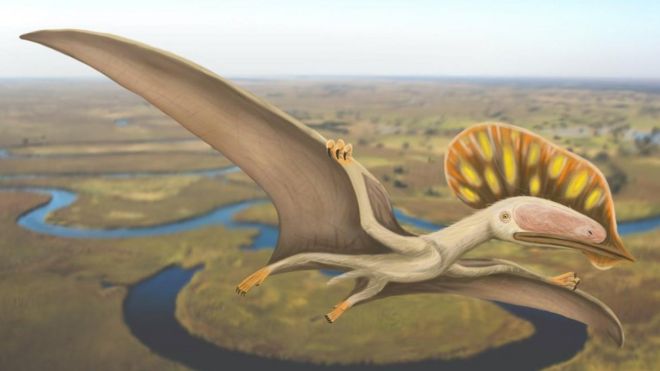
Artist's impression of the Isle of Wight pterodactylImage copyrightMEGAN JACOBS
Image captionThe tapejarid's enlarged crest may have been used for sexual display, researchers said

Isle of Wight pterosaur species fossil hailed as UK first


A fossil of a species of prehistoric reptile, previously found in China and Brazil, has been discovered in the UK for the first time, a university said.

The delicate jaw fragment was collected by an amateur fossil hunter who spotted it while walking his dog at Sandown Bay, Isle of Wight.

The University of Portsmouth identified it as a tapejarid, a flying pterosaur from the Cretaceous period.

Researchers said it demonstrated a wide global distribution of the species.

Palaeontology PhD student Megan Jacobs said she saw the fossil on a friend's kitchen table after he received it from the collector.

She said she recognised the "characteristic tapejarid jaw, including numerous tiny little holes that held minute sensory organs for detecting their food".

'Sexual display'

Ms Jacobs added: "Complete examples from Brazil and China show that they had large head crests, with the crest sometime being twice as big as the skull.

"The crests were probably used in sexual display and may have been brightly coloured.

"It's the first tapejarid found in the UK."

Professor David Martill from the University of Portsmouth, said: "This new species adds to the diversity of dinosaurs and other prehistoric reptiles found on the island, which is now one of the most important places for Cretaceous dinosaurs in the world."

The Isle of Wight fossil had been donated to Dinosaur Isle Museum at Sandown for future display.

The university's findings have been published in the journal Cretaceous Research.


Tuesday, June 16, 2020

In the News: Roman mosaic floor found under Italian vineyard


On May 27, 2020, BBC News reported a really cool archaeological finding in an Italian Vineyard!  An ancient Roman mosaic floor was unearthed! 

Here's the story from BBC News 

Roman mosaic floor found under Italian vineyard


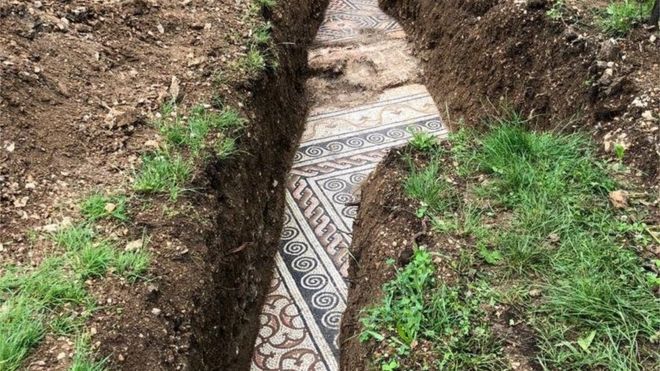
The mosaic floor found under a vineyard in northern ItalyImage copyrightCOMUNE DI NEGRAR DI VALPOLICELLA
Image captionLocal officials said scholars first found evidence of a villa at the site more than a century ago

A Roman mosaic floor has been discovered under a vineyard in northern Italy after decades of searching.

Surveyors in the commune of Negrar di Valpolicella north of Verona published images of the well-preserved tiles buried under metres of earth.

According to officials, scholars first found evidence of a Roman villa there more than a century ago.

Technicians are still gently excavating the site to see the full extent of the ancient building.

Images posted online show the pristine mosaic as well as foundations of the villa.

Presentational white space

A note on the commune website said diggers finally made the discovery "after decades of failed attempts".

Surveyors will liaise with the owners of the vineyard and the municipality "to identify the most appropriate ways to make this archaeological treasure hidden under our feet available and accessible".

Technicians will need "significant resources" to finish the job. But local authorities have pledged to give "all necessary help" to continue with the excavation.

Monday, June 15, 2020

What are Sunspots and Solar Flares?

There's always something to learn, and being a scientist, I love to share science. Science is the foundation of knowledge. So, today, I'm sharing a page from NASA's "Space Place" website so you can learn about Sunspots and Solar Flares!  Read on>>>


Sunspots and Solar Flares

https://spaceplace.nasa.gov/solar-activity/en/


The surface of the Sun is a very busy place. It has electrically charged gases that generate areas of powerful magnetic forces. These areas are called magnetic fields. The Sun’s gases are constantly moving, which tangles, stretches and twists the magnetic fields. This motion creates a lot of activity on the Sun's surface, called solar activity.
Sometimes the Sun’s surface is very active. Other times, things are a bit quieter. The amount of solar activity changes with the stages in the solar cycle. Solar activity can have effects here on Earth, so scientists closely monitor solar activity every day.
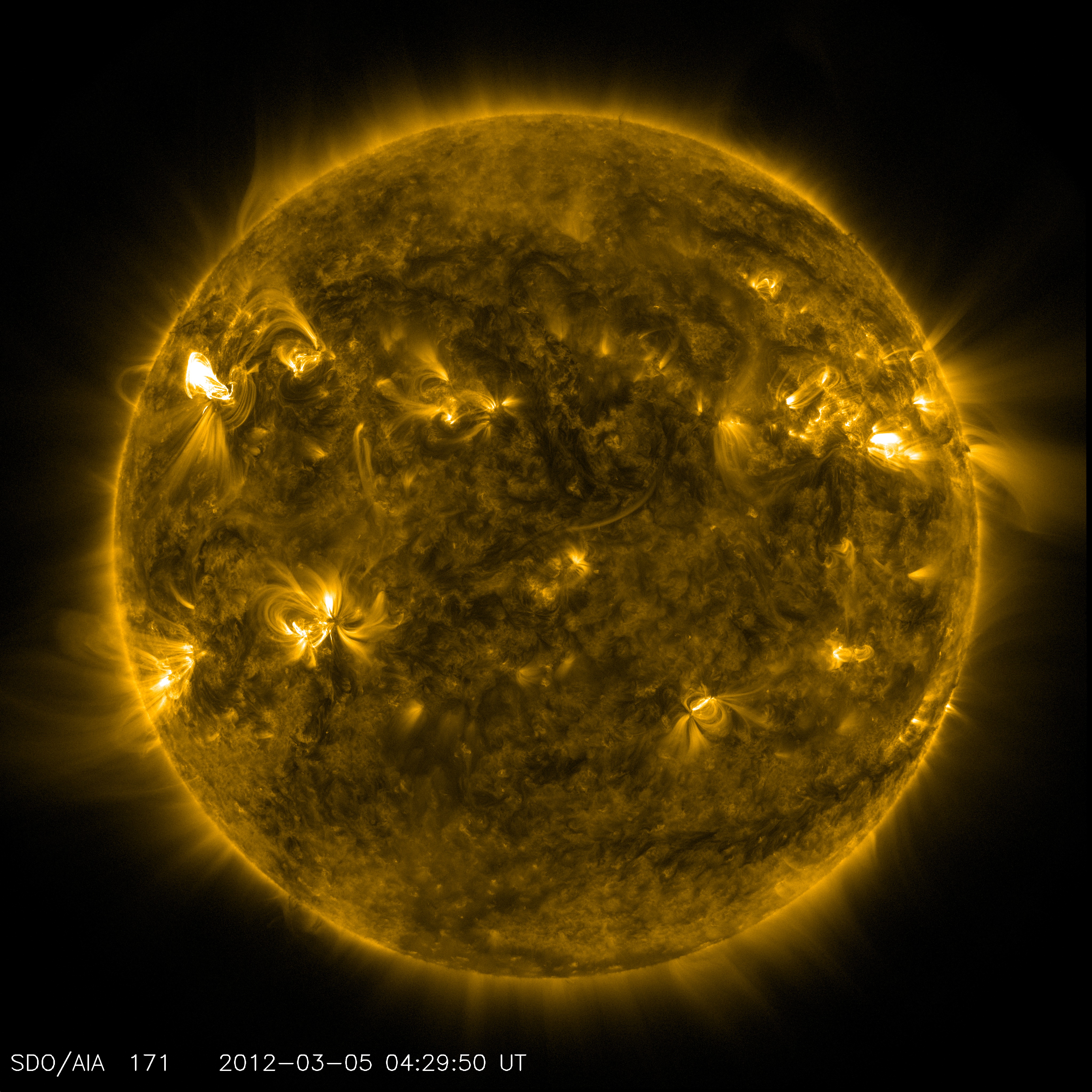
An image of active regions on the sun from NASA’s Solar Dynamics Observatory. The glowing hot gas traces out the twists and loops of the sun’s magnetic field lines.
An image of active regions on the Sun from NASA’s Solar Dynamics Observatory. The glowing hot gas traces out the twists and loops of the Sun’s magnetic field lines. Image credit: NASA/SDO/AIA

Sunspots

Sunspots are areas that appear dark on the surface of the Sun. They appear dark because they are cooler than other parts of the Sun’s surface. The temperature of a sunspot is still very hot though—around 6,500 degrees Fahrenheit!
Why are sunspots relatively cool? It’s because they form at areas where magnetic fields are particularly strong. These magnetic fields are so strong that they keep some of the heat within the Sun from reaching the surface.
In this image, you can see an active region on the sun with dark sunspots.
In this image, you can see an active region on the sun with dark sunspots. Image credit: NASA/SDO/AIA/HMI/Goddard Space Flight Center

Solar Flares

The magnetic field lines near sunspots often tangle, cross, and reorganize. This can cause a sudden explosion of energy called a solar flare. Solar flares release a lot of radiation into space. If a solar flare is very intense, the radiation it releases can interfere with our radio communications here on Earth.
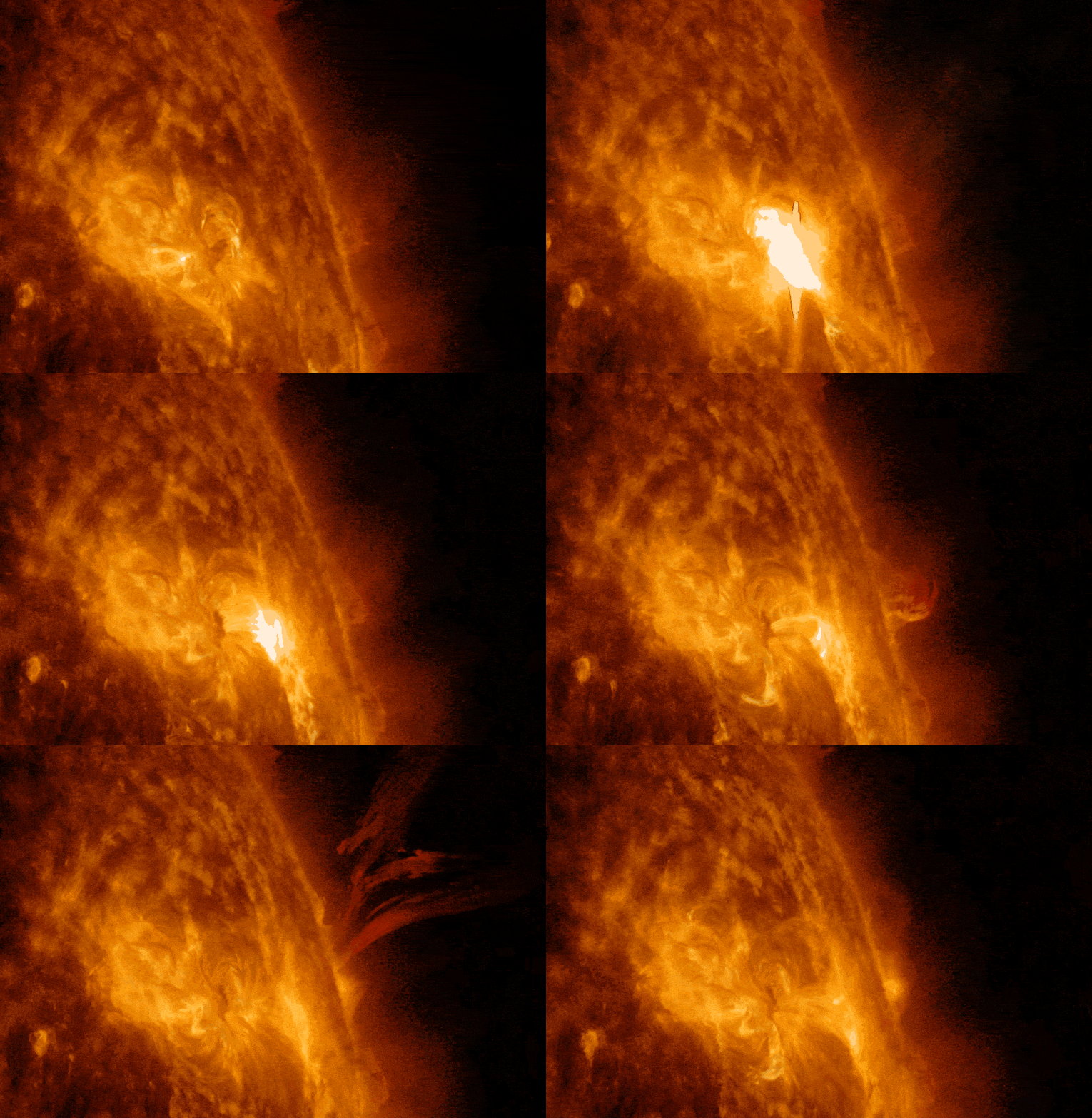
NASA's Solar Dynamics Observatory captured this imagery of a solar flare, as seen in the bright flash. A loop of solar material, a coronal mass ejection (CME), can also be seen rising up off the right limb of the sun.
NASA's Solar Dynamics Observatory captured this imagery of a solar flare, as seen in the bright flash. A loop of solar material, a coronal mass ejection (CME), can also be seen rising up off the right limb of the Sun. Image credit: NASA/SDO/Goddard
Solar flares are sometimes accompanied by a coronal mass ejection (CME for short). CMEs are huge bubbles of radiation and particles from the Sun. They explode into space at very high speed when the Sun’s magnetic field lines suddenly reorganize.

Effects of Solar Activity on Earth

When charged particles from a CME reach areas near Earth, they can trigger intense lights in the sky, called auroras. When particularly strong, a CME can also interfere in power utility grids, which at their worst can cause electricity shortages and power outages. Solar flares and CMEs are the most powerful explosions in our solar system.


'
VIDEO: https://youtu.be/GrnGi-q6iWc
CAPTION: On August 31, 2012 a long filament of solar material that had been hovering in the sun's atmosphere, the corona, erupted out into space at 4:36 p.m. EDT. The coronal mass ejection, or CME, traveled away from the sun at over 900 miles per second. This movie shows the ejection from a variety of viewpoints as captured by NASA's Solar Dynamics Observatory (SDO), NASA's Solar Terrestrial Relations Observatory (STEREO), and the joint ESA/NASA Solar Heliospheric Observatory (SOHO).

Sunday, June 14, 2020

Idiot of the Week: FedEx Employee Mocks George Floyd’s Death as Protesters Pass

There's no shortage of idiots, and they all seem to be supporting one person in particular. This past week in southern New Jersey a white, redneck, conservative idiot mocked peaceful protesters in a horrible, disgusting way.  Here's the story from the NBC Philadelphia:

FedEx Employee Mocks George Floyd’s Death as Protesters Pass
Source: Philadelphia.com June 10, 2020 
A group of white men seen mocking George Floyd's death as Black Lives Matter protesters passed by included a Federal Express employee and a  corrections officer in South Jersey, officials confirmed to NBC10.

NBC10 later learned the man kneeling  on another man laying down along Delsea Drive as a group marched past in Franklin Township on Monday. is a FedEx employee. A NJ corrections officer was off to the side filming.

FedEx told Memphis, Tennessee, NBC affiliate WMC-TV late Tuesday that another person involved in the counter protest is no longer employed by the logistics company. FedEx said "we do not tolerate the kind of appalling and offensive behavior depicted in this video."


The NJ Department of Corrections said in a statement that one of the men involved was a corrections officer at Bayside State Prison. "We have been made aware that one of our officers from Bayside State Prison participated in the filming of a hateful and disappointing video that mocked the killing of George Floyd," an NJ Department of Corrections statement said. That person, who the statement did not identify, has been suspended and banned while the agency investigates.


The display sent shocked reactions through the crowd and on social media as clips racked up thousands of views.

The protesters, who had notified police of their route and were flanked by police SUVs, were moving down Delsea Drive when they passed a firewood business along the route, protesters told NBC10 and documented in social media videos.

The videos showed a group with Trump 2020 flags and a "thin blue line" flag, along with an "all lives matter" sign. You could hear shocked reactions as one man, whom NBC10 could not definitively identify, knelt on another man who lay face-down on the ground. The man kneeling was also seen shouting at the protesters.

"It automatically brought me to tears," organizer Daryan Fennal of Franklinville said. "The display yesterday showed me that racism is real, racism is alive, it's right next door to you."

Saturday, June 13, 2020

Decent Compilation: The Flash of 80 Years (Hardcover)

I recently bought and read the hardcover collection of "The Flash of 80 Years" by DC Comics. This hardcover book contains reprints from the three Flash comic book characters, from Jay Garrick in the 1940s to Wally West in the 1990s, and Barry Allen from the 1960s-80s, who returned to life in the 2000s. You could read it, or better yet, take it out from a Library. Here are my thoughts: 
  I love the Flash character and have since I've been reading comics in the early 1970s, so the Barry Allen Flash stories I enjoyed. I also loved the Jay Garrick stories from the 1940s. But I didn't care for the 1990s Wally West stories. I never cared for the character in the first place, so my opinion of his stories was already tainted. I didn't read the Flash comics post 1986 (when Barry Allen vanished in the Crisis on Infinite Earths) until he re-appeared in the early 2000s. 
   There are also pages written by the writers or illustrators of various time periods they wrote or illustrated the Flash, which were interesting. 
   I really liked the collage of old covers of the Flash comic book run, and they were scattered throughout the book. 
   Bottom line- It's a decent compilation, but one that I wouldn't pick up and read again. It's worth at least one read-through. 

ABOUT THE BOOK FROM AMAZON - CELEBRATE COMICS HISTORY WITH THE 80TH ANNIVERSARY OF FLASH COMICS #1 AND THE DEBUT OF THE FASTEST MAN ALIVE!

Featuring iconic stories selected from eight decades of the Flash: THE CLASSIC FIRST APPEARANCES OF ALL THREE FLASHES-- BARRY ALLEN, JAY GARRICK, AND WALLY WEST MORE THAN 100 PAGES OF NEVER-BEFORE-REPRINTED STORIES INCLUDING A Golden Age Rose and Thorn saga by ROBERT KANIGHER and JOE KUBERT (Flash Comics #89 and #96, 1947, 1948) "Nobody Dies" by WILLIAM MESSNER-LOEBS and GREG LaROCQUE (Flash #54, 1991) "1981--A Flash Odyssey" by CARY BATES and CARMINE INFANTINO (The Flash #300, 1981) and more!

Commentary from former Flash writers, artists, and editors including MARK WAID FRANCIS MANAPUL PAUL KUPPERBERG WILLIAM MESSNER-LOEBS ROY THOMAS DAN DiDIO TODD HELBING...and much more

Friday, June 12, 2020

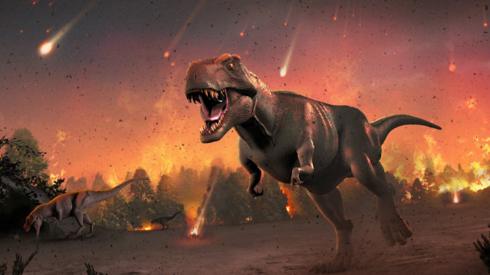
New Research: Dinosaur asteroid's trajectory was 'perfect storm'

For the last couple of months since I read "The Rise and Fall of the Dinosaurs," I've been on a quest for knowledge about dinosaurs and prehistoric times. On May 25, BBC News published a story about a new research finding on the giant Asteroid that smashed into the southern Gulf of Mexico (the northern Yucatan Peninsula of Mexico, specifically), that explained why it was so deadly, and how it changed the world's short-term climate. It's all about the angle of trajectory... Here's the story from the BBC and a video interview, too.
Dinosaur asteroid's trajectory was 'perfect storm'
By Jonathan Amos,   BBC Science Correspondent

A clear picture is emerging of why the asteroid that struck Earth 66 million years ago was so catastrophic.

The space object, which wiped out 75% of all species including the dinosaurs, hit the worst possible place on the planet and - according to new research - at the most lethal angle.

Investigations at the crater site, together with computer simulations, suggest the impactor dug into the crust at an inclination of up to 60 degrees.

This exacerbated the climatic fallout.

We know that the target rocks, in what is now the Gulf of Mexico, contained huge volumes of sulphur from the mineral gypsum. When this material was thrown high into the atmosphere and mixed with water vapour, it produced a "global winter".

And the angle of attack ensured this environmental crisis was intense and prolonged.

"At 45 to 60 degrees, the impact is very efficient at vaporising and ejecting debris to high altitude. If the impact happens at shallower or much steeper angles, the amount of material that's put into the atmosphere that can then have climate-changing effects is significantly less," explained Prof Gareth Collins from Imperial College London.

"It's evident that the nature of the location where this event happened, together with the impact angle, made for a perfect storm," he told BBC News.

The majority of plant and animal life on Earth succumbed to the the challenging conditions.

Prof Collins' and colleagues' work is published in the journal Nature Communications.


Prof Collins is part of an international team that's been studying the anatomy of the crater associated with the calamitous asteroid strike.

Today, this 200km-wide structure is positioned under Mexico's Yucatan Peninsula, with its best preserved central portions sitting just offshore of the port of Chicxulub.

It's hard to grasp the scale of the forces that produced it.

The impactor, thought to be about 12km in diameter, punched an instantaneous hole in the crust that was probably some 30km deep. As fluidised rocks at the base of this bowl rebounded, they created in just a few minutes a mountain that was higher than Everest. This didn't last, however, and it fell back, to leave a prominent inner ring of hills, or peaks.

What's interesting from Prof Collins' perspective is the asymmetry that was frozen into the Chicxulub structure.

For example, if you look at the centres of the crater, of its peak ring and of the uplifted rock that underlies the crust in Earth's mantle - these points do not map directly on top of each other. They're actually aligned in a northeast-southwest direction, with the crater centre in between the centres of mantle uplift and peak-ring formation.

This is a vital clue in determining not only the direction from which the asteroid arrived but the angle at which it hit the planet.

Credit: BBC: Simulation: The impact produces an asymmetry in the structure of the crater

The Imperial researcher ran a number of simulations on the UK Science and Technology Facilities Council (STFC) DiRAC High Performance Computing Facility. The only way he can reproduce the geometry is by having the asteroid come in from the northeast and strike the Earth at an angle of roughly 60 degrees.

Prof Collins said: "If you run the model at different impact angles, at 30 degrees and at 45 degrees, say, you can't match the observations - you get centres of mantle uplift and of the peak ring on the downrange side of the crater centre. And for a straight overhead impact, at 90 degrees, the centres are all on top of each other. So, that's doesn't match the observations, either."

Imperial colleague and co-author Prof Joanna Morgan added: "Knowing the direction of impact means we now know which part of the target site was subjected to the greatest shock pressures.

"The sulphur-bearing and carbon-bearing sedimentary rocks actually thicken as you go from east to west, and to the south. So this result means we're degassing more of those sediments than we would if you just took an average value for their thickness."

And Prof Sean Gulick from the University of Texas at Austin, US, told BBC News: "This new modelling provides a clear answer to the angle of the impact and the direction of the impact that largely settles a long-standing debate on what was downrange of the impact.

"Also critical is that a 60-degree angle is in the range of the worst options for injecting large volumes of vaporised and ejected sulphur-rich rocks into the atmosphere.

"Thus these results are critical for understanding potential 'kill mechanisms'," the co-author explained.

Gulick and Morgan led the expedition that drilled into the Chicxulub Crater in 2016 to recover some of its rocks for an analysis. A follow-up, high-resolution seismic survey is due to take place late this summer that will provide an enhanced 3D view of the structure.

Thursday, June 11, 2020

Top 10 U.S. Record-Breaking Extreme Weather Events of the Decade

U. S. News and World Report recently ranked the Top 10 U.S. Record-Breaking Extreme Weather
Events of the Decade.  The ranking considered cost, deaths, injuries, size and rarity by meteorological standards. As a meteorologist who focuses on tropical cyclones, I concur with this ranking, although the death toll from Hurricane Maria was the largest.
IMERG data for Harvey were compiled for the period from August 23 to 29, 2017 as it moved through the Gulf of Mexico and stalled over Texas. The IMERG totals showed over 30 inches of rainfall had occurred in the Houston metro area and part of the western Gulf of Mexico.
Credits: NASA JAXA, Hal Pierce

Here are the top 10 record-breaking U.S. weather events of the last decade:
US News and World Report By Cecelia Smith-Schoenwalder, Staff WriterFeb. 18, 2020,   


Hurricane Harvey (2017)

"To say that the rainfall totals from Harvey were extreme might even be an understatement," the report said. The hurricane killed 68 people.

Hurricane Sandy (2012)

Sometimes referred to as a "Frankenstorm," Hurricane Sandy was one of the most intense and damaging East Coast storms of all time. "Sandy served as a kind of wake-up call for the East Coast, letting residents understand how vulnerable the populated coastal areas could be to big storms," the report said.

Hurricane Maria (2017)

The hurricane made landfall in Southeast Puerto Rico after bringing major destruction to Saint Croix in the U.S. Virgin Islands. It was the most catastrophic hurricane to hit Puerto Rico, causing $90 billion in damages. The storm, which caused power outages in Puerto Rico that lasted up to 11 months in some areas, was indirectly responsible for nearly 3,000 deaths.

Hurricane Irma (2017)

The Category 5 storm caused major damage to the U.S. Virgin Islands before being downgraded to a Category 4 and striking the Florida Keys. It caused roughly $50 billion in damages.

Animation: https://youtu.be/uOaQhPQasGI
Caption: This animation of NOAA's GOES East satellite imagery from Sept. 12 at 8:15 a.m. EDT (1215 UTC) to Sept. 14 ending at 8:30 a.m. EDT (1230 UTC) shows Irma remnants moved from Missouri to the Mid-Atlantic and New England. Meanwhile Hurricane Jose continued making a loop in the Atlantic Ocean between Bermuda and the Bahamas. TRT: 00:22 Super(s): Courtesy: NASA-NOAA GOES Project

Heat and drought (2012)

Across the summer months in the Corn Belt, heat and drought killed crops and reduced lake and river water levels. From Nebraska to Ohio, about $34 billion in agricultural losses were logged.

Tornado super outbreaks (2011)

The largest tornado outbreak ever recorded saw over 200 tornadoes across the Southeast. On April 27, 122 tornados killed 321 people, the majority of which were in Alabama.

Southern Plains drought (2010-2011)

The drought affected Texas, Oklahoma, New Mexico, Arizona, Kansas and Louisiana. It was linked to 95 heat-related deaths.

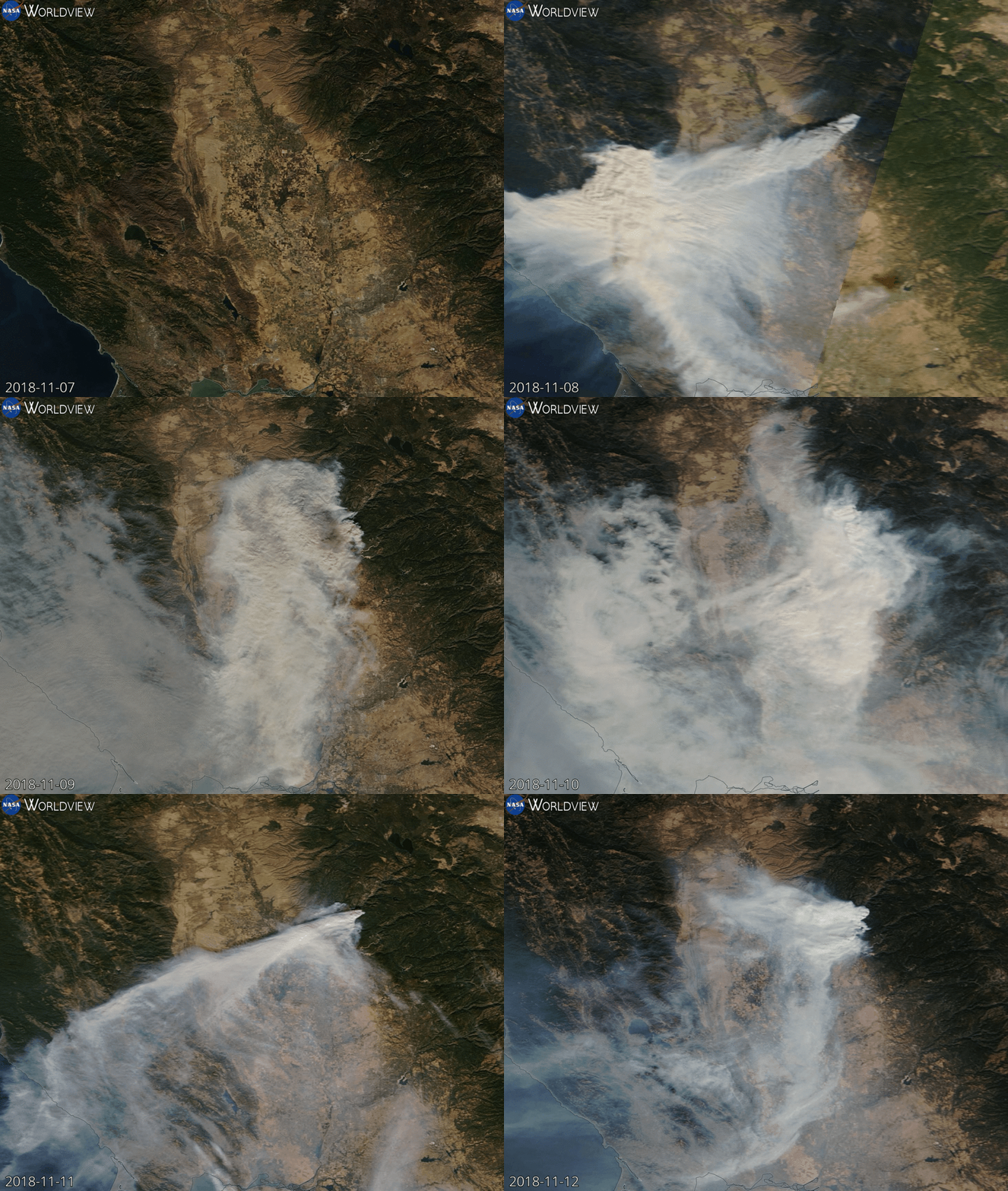
California winds, heat and wildfires (2017-2019)

The Camp Fire in Northern California in 2018 was the deadliest and most destructive wildfire in the state's history. During this time, California also dealt with the Carr Fire and the Tubbs Fire. The utility PG&E has started the controversial practice of shutting off power to areas that expect to see high wind events in order to limit the number of fires its equipment could spark.


This animated GIF from the Worldview webpage shows the growth of the Camp Fire from November 7 through November 12, 2018.
Credits: NASA Worldview, Earth Observing System Data and Information System (EOSDIS).


Hurricane Michael (2018)

The Category 5 hurricane made landfall near Panama City, Florida. The storm killed 57 people and cost the economy roughly $25 billion.
Hurricane Michael frequently produced rainfall totals greater than 10 inches (254 mm) along its track. IMERG data indicated that the heaviest rainfall accumulation occurred off the Yucatan where were over 20 inches (512 mm) were estimated. Michael’s approximate 0000Z and 1200Z (8 p.m. EDT and 8 a.m. EDT) locations are shown overlaid on this analysis. Credit: NASA/JAXA, Hal Pierce


California drought (2012-2015)

Four years of insufficient rain and snow caused the worst drought in nearly 40 years. It brought wildfires, water shortages and agricultural losses.

Who I am

I'm a simple guy who enjoys the simple things in life, especially our dogs. I volunteer for dog rescues, enjoy exercising, blogging, politics, helping friends and neighbors, participating in ghost investigations, coffee, weather, superheroes, comic books, mystery novels, traveling, 70s and 80s music, classic country music,writing books on ghosts and spirits, cooking simply and keeping in shape. You'll find tidbits of all of these things on this blog and more. EMAIL me at Rgutro@gmail.com - Rob

A Classic Country Music Station to Enjoy