Showing posts with label climate change. Show all posts

Thursday, July 2, 2026

Climate Science: Mysterious 'cold blob' in the Atlantic is a sign of the Gulf Stream weakening

As a scientist (now retired) it's maddening to see that news outlets rarely report science findings, especially those that are relevant to our rapidly changing climate. Unfortunately, the current state of the country doesn't believe in science, sadly. But there are those of us who DO, and a recent finding appears to be a harbinger of change for a large area of the Northern Hemisphere and Atlantic Ocean. Here's the story.

(Image: Aqua satellite image of the North Atlantic Ocean on June 10, 2026. Credit: NASA) 

Mysterious 'cold blob' in the Atlantic is a sign of the Gulf Stream weakening — and that's bad news for the US East Coast 

The Atlantic's enigmatic "cold blob" has once again been linked to a weakening of key ocean currents and a devastating climate tipping point.

Patrick Pester, Live Science, June 10, 2026

A mysterious "cold blob" in the Atlantic Ocean is a sign that key ocean currents are weakening, a new study has found, with potentially devastating long-term impacts on our climate and weather.

The cold blob, or North Atlantic Warming Hole, is an area south of Greenland and Iceland where average sea surface temperatures have actually been going down. Researchers have been working to understand the blob for years, given that it bucks the global trend of Earth getting warmer.

The new research, published May 28 in the journal Geophysical Research Letters, supports previous interpretations that the blob's existence points to a weakening of ocean currents known as the Atlantic Meridional Overturning Circulation (AMOC).

The AMOC maintains Europe's relatively mild temperatures, particularly in winter, and helps regulate climate across Europe, Africa and America. Researchers have warned that a weakening AMOC has serious environmental consequences, with its collapse considered a major potential tipping point, or key threshold within Earth's systems, beyond which substantial and irreversible environmental change will occur.

WHAT IT MEANS -  Scientists are uncertain about the rate at which the AMOC is weakening, with one recent study projecting that it will slow down by around 50% by 2100. If the AMOC were to collapse completely, temperatures in parts of the Northern Hemisphere could plummet by some 18 to 27 degrees Fahrenheit (10 to 15 degrees Celsius), extreme droughts would be unleashed in southern Europe, and the sea level would rise along the northeastern coastline of North America.

"Given the well-established existence of a tipping point of the AMOC, as well as recent studies finding a range of different "early warning signals" of the ocean circulation approaching such a tipping point, the strong evidence for a weakening AMOC is a serious concern for society and policy," the authors of the new study wrote in the study.

The AMOC acts like a conveyor belt, carrying water, nutrients, and absorbed carbon dioxide from the tropics northward. This warm water heats up the atmosphere, with westerly winds then carrying the resulting warm air towards land, keeping Europe relatively mild.

"Our analysis supports the interpretation of the observed "cold blob" as a sign of a weakening AMOC," the authors wrote.

There are still uncertainties surrounding the cold blob and the weakening AMOC, with work ongoing to better understand these phenomena. Meanwhile, the Trump administration is set to remove 900 deep-sea monitoring instruments from the Atlantic and Pacific Oceans, which include sensors that would have kept tabs on the AMOC.

Wednesday, May 13, 2026

Key Atlantic ocean current is much closer to collapse than scientists thought

 Here's a very concerning finding- that the Gulf stream current that transports warmth from the Gulf of Mexico north along the U.S. East coast and over to Eastern Europe is weakening at a faster rate than suspected. That current is what keeps the U.S. East coast and eastern Europe temperate in the winter, and keeps sea levels down along the U.S. East Coast. Today's blog shares the new findings.. 

(Ocean flows colored with sea surface temperature data, yellow is the warmer waters of the Gulf stream. Credit: NASA Goddard/SVS) 


'Nations need to prepare now': Key Atlantic ocean current is much closer to collapse than scientists thought

LIVE SCIENCE, April 2026 

Atlantic Ocean currents that are vital for keeping Earth's climate in check will halve in strength by 2100 and may be closer to collapse than first thought, a new study finds.

The Atlantic Meridional Overturning Circulation (AMOC) acts as an oceanic conveyor belt, circulating warm water north from the tropics and cold water south. This regulates climates across Europe, Africa and America while also sustaining aquatic life.

Now, a study estimates the AMOC will slow down between 43% and 59% by 2100 — a 60% stronger weakening than past models predicted. The research corrects for biases in previous estimates by including the temperature and saltiness of the Atlantic Ocean's surface, according to the study published Wednesday (April 15) in the journal Science Advances.

This "more substantial AMOC weakening" means that a critical planetary system is closer to a tipping point — an irreversible "point of no return" for the climate — than many past models suggest, the authors wrote in the study.

However, other experts note that the predicted magnitude and speed of an AMOC slowdown varies greatly from study to study.

"In my opinion there is a need to interpret new results for each study into a wider context," María Paz Chidichimo, an expert on ocean circulation at the National Scientific and Technical Research Council (CONICET) and National University of San Martín in Buenos Aires, Argentina, told Live Science in an email.

"Studies predict AMOC decline on a range from small decline to large decline, but I think the magnitude and timing of AMOC decline are still uncertain given the large spread in model projections," she added.

Laura Jackson, an expert in North Atlantic ocean currents at the Met Office in the U.K., agreed. "It is still an open question as to which model AMOC projections are most likely," she told Live Science in an email.

(Animation: Ocean flows colored with sea surface temperature data, the yellow indicates the warm waters of the Gulf stream and how they flow up the U.S. East coast and over to eastern Europe. Credit: NASA Goddard / SVS) 

Catastrophic collapse 

An AMOC collapse would last for hundreds to thousands of years and have catastrophic consequences. It would send temperatures in northern Europe plummeting while southern Europe experiences extreme droughts. The sea level would rise along the northeast coast of North America. Disruption would spread across food webs and ecosystems in the ocean and on land — for example, the amount of land available for growing wheat and maize, which supply two-fifths of global calories, would be cut by more than half.

Modeling the AMOC slowdown 

Observations reveal that the AMOC has weakened compared with its 1850 to 1900 baseline. Previous research has attempted to estimate the strength and pace of the AMOC slowdown, with some studies finding minimal weakening by the end of the century while others predict an imminent collapse.

The predicted AMOC is "so weak that it is then very likely on the way to full shutdown," Stefan Rahmstorf, a professor of ocean physics who heads the Earth system analysis department at the Potsdam Institute for Climate Impact Research in Germany, told Live Science in an email.

Even so, experts told Live Science that AMOC model estimates are largely driven by which variables are included in the analyses, so results can vary. And although the new study corrects for previous biases, there "remains uncertainty in how well models can simulate and predict changes in the AMOC," Thornalley said.

Focusing too heavily on an AMOC collapse may not be the most helpful path forward, Chidichimo said. "We have enough scientific evidence of AMOC variability and slowdown, and we are already experiencing environmental changes associated with AMOC change which have important socioeconomic impacts worldwide," she said. "Nations need to prepare now."

Thursday, April 30, 2026

Human-driven climate change is slowing Earth's rotation at a rate not seen in 3.6 million years

New research published in the Journal of Geophysical Research: Solid Earth, confirmed the Earth is slowing in rotation rate as a result of sea levels rising. Read today's blog to find out how.
(Image: North and South America as seen by GOES-East satellite on April 02, 2026. Credit: NOAA) 


Human-driven climate change is slowing Earth's rotation at a rate not seen in 3.6 million years

LIVe SCIENCE By Stephanie Pappas published March 20, 2026

Today's sea level rise is significant enough to slow the rotation of the planet by just over a millisecond per century.

Human-driven climate change is slowing Earth's rotation at a rate not seen in 3.6 million years, with sea level rise increasing the length of days by 1.33 milliseconds per century, according to a new study.

Earth spins faster when its mass is more concentrated, just as twirling figure skaters pull in their arms to speed up and spread out their arms to slow down. Rising sea levels have long been known to redistribute that mass and change the planet's spin, but the newly identified rate is unprecedented, scientists say.

Many factors influence Earth's spin speed. The moon's pull on the planet is the most significant over the long term. Its gravitational pull creates a bulge in the planet that slows Earth's rotation rate, Michael Mann, a climatologist at the University of Pennsylvania who was not involved with the new study, told Live Science. The moon's influence increases Earth's day length by about 2.4 milliseconds per century.

However, this 2.4 millisecond rate is offset by an effect called glacial isostatic adjustment, which is the slow rise of the planet's crust that continues to occur after the retreat of the ice sheets. Glacial isostatic adjustment shortens the day length by about 0.8 millisecond per century, leading to a background lengthening over time of 1.71 milliseconds per century (with about 0.1 millisecond of uncertainty in the observations).

Other, shorter-term phenomena also affect day length, including strengthened winds during El Niño events, which slow the planet's rotation by about a millisecond per century, Mann said.

However, in recent years, the climate seems to be playing an increasing role in altering Earth's rotation, said study co-author Mostafa Kiani Shahvandi, a geoscientist at ETH Zurich. "I wanted to know if this was unusual or something like this happened in the past," Shahvandi told Live Science. "As it turned out, it is quite anomalous. The effect is therefore anthropogenic [caused by humans]."

Shahvandi and study co-author Benedikt Soja, a professor of space geodesy at ETH Zurich, turned to the fossils of shelled single-cell organisms called foraminifera to peer back millions of years into Earth's day length. Changes in the oxygen content of these fossils could reveal sea levels when the organisms were alive, from which the researchers could extrapolate day lengths.

They found that today's 1.33-millisecond-per-century increase in day length was among the fastest changes seen in the past 3.6 billion years. "This is expected to get even larger and even bigger than the effect of the moon," Shahvandi said.

One episode around 2 million years ago saw a similar increase in day length of 2.1 milliseconds per century, the researchers found. That was in the Early Pleistocene, during a period when carbon dioxide in the atmosphere and temperatures rose. There is some uncertainty in the historical estimate, meaning that this period may have seen a similar increase in day length as today, or that today might be faster.

Under a future warming scenario where greenhouse gases increase, the day could lengthen by 2.62 milliseconds per century by 2080, Shahvandi and Soja reported in their study, which was published March 10 in the journal JGR Solid Earth.

Although the impact would likely not be perceptible to humans, the findings have other real-world implications. For example, Mann said, instruments that require precise knowledge of Earth's rotation rate, such as those on spacecraft, may need to be recalibrated. Other precise timekeeping applications, such as in computing, could be affected, Shahvandi said.

The findings also underscore the rapidity of modern warming. "It tells us about the rapid climate change," Shahvandi said, "[the] melting of snow and ice in polar ice sheets and mountains glaciers, and increase in the sea levels."

Article Sources Kiani Shahvandi, M., & Soja, B. (2026). Climate‐Induced Length of Day Variations Since the Late Pliocene. Journal of Geophysical Research: Solid Earth, 131(3). https://doi.org/10.1029/2025jb032161

Tuesday, April 14, 2026

Antarctica could warm 1.4 times faster than the rest of the Southern Hemisphere

Any educated person knows that climate change is happening, and that Humans and the pollution they've caused is exacerbating (speeding up) the process at a rate greater than some environments can handle. New research indicates Antarctica could warm faster than the rest of the southern hemisphere, and that's alarming. Today's blog explains from an article in Live Science. 

(Image: This color picture of Antarctica is one part of a mosaic of pictures covering the entire Antarctic continent taken during the hours following Galileo's historic first encounter with its home planet. The view shows the Ross Ice Shelf. Credit: NASA)


Antarctica could warm 1.4 times faster than the rest of the Southern Hemisphere 

LIVE SCIENCE, March 24, 2026

Antarctica could heat up 1.4 times faster than the rest of the Southern Hemisphere over the coming decades, which would lock in extreme sea-level rise and ravage polar ecosystems, a new modeling study shows.

This acceleration of warming in Antarctica relative to other regions, known as Antarctic amplification, would likely occur if global temperatures reached 3.6 degrees Fahrenheit (2 degrees Celsius) above preindustrial levels, according to the study. The world has already warmed by 2 F (1.1 C), and the pace at which new temperature records are being set is intensifying. If emissions stay around current levels, we will likely reach 3.6 F of warming around 2050 — but if emissions keep rising, we could hit that threshold around 2040.

The new research is among the first to find a clear sign of Antarctic amplification, which has been hard to detect due to the Southern Ocean's enormous capacity to absorb heat and the powerful circumpolar currents that isolate the frozen continent from rising temperatures. Yet most scientists think Antarctic amplification will happen, because amplification in the Arctic is already underway.

"For many years, Antarctica seemed isolated from the effects of increasing global temperatures," Ariaan Purich, a senior lecturer and climatologist at Monash University in Australia who was not involved in the research, told Live Science in an email. "In this new study, the authors propose that long-term surface warming of the ocean around Antarctica, projected by climate models over the coming century, leads to Antarctic amplification."

(Image: Antarctic sea ice maximum extent, September 10 2023. Credit: NASA) 

Arctic amplification has been documented for years, with temperatures in this region climbing about four times faster than the global average increase over the past five decades. The main mechanism driving Arctic amplification is the ice-albedo feedback, where the melting of snow and ice accelerates warming because water reflects less heat back to space. Where there once used to be reflective sea ice, there is now an ocean that absorbs more heat from sunlight. This causes more ice and snow to melt, in turn exposing even more heat-absorbing water.

Antarctica behaves differently, partly because swirling ocean and wind currents shield the continent from rising air and sea temperatures elsewhere in the world. Contrary to the Arctic, most of Antarctica experienced only gradual warming and no declines in sea ice until about a decade ago, Purich said.

But then, between 2014 and 2016, Antarctica lost as much sea ice as the Arctic had lost in four decades. The continent hasn't bounced back since, Purich said, with exceptionally low winter sea ice extent recorded in 2023, in particular.

"We're now seeing abrupt changes occurring in Antarctica, at very rapid rates," Purich said. "With low Antarctic sea ice coverage, there is now the potential for the ice-albedo feedback to start exacerbating warming of the southern high latitudes."

Thursday, March 26, 2026

Birds are declining faster and faster in 3 US hotspots, new study finds

Climate warming has adversely affected bird populations. Researchers have revealed that North American birds are declining at an accelerating rate in three regional hotspots associated with intense agriculture.
(Photo: Male house finch and white breasted nutchatch at the Fort Valley Experimental Forest; AZ; USA. Credit USDA)

Birds are declining faster and faster in 3 U.S. hotspots, new study finds 

 By Patrick Pester published March 4, 2026, Live Science

Bird populations are in free fall across North America. And in some hotspots their decline is accelerating, a new study reveals.

Wild bird numbers declined at an accelerating rate in California, the Midwest and the Mid-Atlantic between 1987 and 2021. Across these hotspots, losses were associated with high-intensity agriculture, according to the study.

Although the study, published Feb. 26 in the journal Science, shows a correlation between declining bird populations and intense agriculture, it doesn't definitively prove that agriculture is driving the increased decline or identify which agricultural activities might be responsible.

However, signs of intense agricultural activity consistently proved to be the best predictor of increased bird decline, which mirrors similar research conducted in Europe. The researchers also found that declines were stronger in warming areas, suggesting that rising temperatures due to climate change were driving some bird disappearances.

Birds perform important roles in the ecosystem, including spreading plant seeds and keeping insect populations under control. For decades, scientists have been concerned that bird populations are falling due to human activities, both in North America and globally — a plight shared by many other animals. What's special about the new research is that it reveals how the decline in North America has accelerated since the late 1980s.

"We are not talking about the decline but the acceleration of the decline," study lead author François Leroy, a postdoctoral researcher in macroecology at The Ohio State University, told Live Science. "We see that this decline is getting faster and faster with the intensification of human activities."

Common birds ‪—‬ like red-winged blackbirds (Agelaius phoeniceus), house finches (Haemorhous mexicanus) and American crows (Corvus brachyrhynchos) ‪—‬ were among the native species found to have suffered an accelerated decline.

A 2019 study published in the journal Science estimated that the North American bird population decreased by 2.9 billion individual birds between 1970 and 2017. That estimate equated to a drop of 29%, which is almost double the 15% decline documented in the new study. However, the 2019 study also covered an earlier and longer time period when there may have been more severe losses. CLICK HERE FOR FULL ARTICLE

Tuesday, October 14, 2025

Sierra Nevada's glaciers Will be gone in 75 years

Climate change is visible everywhere. From the recent revealation of an island in Alaska from melting ice, to sea level rise, to more intense hurricanes and typhoons. This week's blog is about another observation regarding a retreating glacier in the Sierra Nevada Mountains, uncovering land that hasn't been seen since before the Ice Age. 

(Caption: Repeat photography of Maclure Glacier in Yosemite National Park. September 1914 versus September 2021. Portrait size image showing two photos of Maclure Glacier in Yosemite National Park. September 1914 (above) versus September 2021 (below). In 2021, ice coverage is considerably less compared to the photo taken in 1914. Image credit: United States Geological Survey and Greg Stock (National Park Service).)

Yosemite's glaciers have survived 20,000 years — but we could be the first people to see Sierra Nevada ice-free

LIVE SCIENCE, By Stephanie Pappas, Oct 1, 2025

New research finds the disappearance of glaciers in the Sierra Nevada will be unprecedented in the human history of North America.

The mountain glaciers of Yosemite National Park are projected to melt away in 75 years or less. Now, new research finds that their loss will be the first time humans have ever seen the Sierra Nevada mountains without ice.

According to a new study, published Wednesday (Oct. 1) in the journal Science Advances, the Sierra Nevada's glaciers have not disappeared since the last ice age. Because they reached their maximum extent during the ice age about 30,000 years ago, and because humans aren't thought to have arrived in North America until after 30,000 years ago, that means people have never witnessed an ice-free Sierra Nevada, according to the study.

"Anthropogenic climate change is therefore likely creating a no-analog scenario in the western United States within the current interglacial," the researchers wrote in the new paper.

Geoscientists have long known that the extent of the mountain glaciers in what is now the western U.S. shrank and grew over the last 11,700 years, a timeframe known as the Holocene. In the warm early Holocene, the Sierra glaciers got smaller before expanding again in the mid-to-late Holocene. They've since shrunk in the last century, contracting from formidable ice walls hanging above steep slopes into small snowfields barely clinging to existence.


(Caption: Maclure Glacier in Yosemite National Park. Sierra Nevada's glaciers are expected to vanish by 2100. (Image credit: Andrew Jones))

What was unclear was whether these glaciers ever fully disappeared. Some studies of glacial sediments in lakes below the ice suggest they may have vanished in the early Holocene, only to reform 3,000 years ago.

To get a clearer picture, the researchers tested samples of boulders and recently-exposed bedrock from near four retreating glaciers in and near Yosemite National Park: Conness, Maclure, Lyell and Palisade. They were looking for particular variations of carbon and the element beryllium that are formed only when cosmic rays from the sun hit the rock.

Since these variations don't form when the rocks are buried and sheltered from the sun, their presence can reveal when the rock was exposed. And because the variations decay away at known rates, they also provide a "clock" that gives a date for that exposure.

The results suggest that the rocks beneath these long-lasting glaciers have been exposed for between less than 100 to several thousand years, and that none of the glaciers have ever fully disappeared — though the eastern section of the Lyell glacier may have been even smaller than it was today during the early Holocene. This tracks with the current warming trends, the study authors wrote: California's recent summer warming of 3.6 degrees Fahrenheit (2 degrees Celsius) over pre-industrial temperatures is comparable to or larger than the climate 11,000 years ago.

Prior to the Holocene, during the ice age — scientifically known as the Last Glacial Period — the Sierra Nevada glaciers would have been beefier, peaking around 30,000 years ago. Humans are confirmed to have been living in North America as early as 23,000 years ago. Some controversial archaeological evidence puts people in northwestern New Mexico around 30,000 years ago. Either way, it's unlikely that humans ever set eyes on an ice-free Sierra Nevada.

"[Our] reconstructed glacial history indicates that a future glacier-free Sierra Nevada is unprecedented in human history," the authors wrote.

Tuesday, November 5, 2024

Alarming Findings: Antarctic ‘greening’ at dramatic rate

Any educated person knows that the Earth is warming faster than it normally would because of the excessive amount of pollutants we are putting into the atmosphere. We've seen powerful hurricanes this year, like the Category 5 Hurricane Milton, and Cat 4 Helene. Scientists have observed very warm sea surface temperatures in the Gulf of Mexico and Atlantic Ocean. We've seen plants that only grew in the U.S. South thriving in the U.S. Mid-Atlantic. Now, using satellite data, scientists have seen a warming and "greening" in the Antarctic! If you thought it was all covered with ice and snow, think again. That's the story of today's blog.

 (Photo: A moss-covered slope, with the sea and ice chunks visible in the background Green Island. Credit Matt Amesbury)

Antarctic ‘greening’ at dramatic rate 

Vegetation cover across the Antarctic Peninsula has increased more than tenfold over the last four decades, new research shows.

The Antarctic Peninsula, like many polar regions, is warming faster than the global average, with extreme heat events in Antarctica becoming more common.

The new study – by the universities of Exeter and Hertfordshire, and the British Antarctic Survey – used satellite data to assess how much the Antarctic Peninsula has been “greening” in response to climate change.

It found that the area of vegetation cover across the Peninsula increased from less than one square kilometre in 1986 to almost 12 square kilometres by 2021.

Published in the journal Nature Geoscience, the study also found this greening trend accelerated by over 30% in recent years (2016-2021) relative to the full study period (1986-2021) – expanding by over 400,000 square metres per year in this period.

In a previous study, which examined core samples taken from moss-dominated ecosystems on the Antarctic Peninsula, the team found evidence that rates of plant growth had increased dramatically in recent decades.

This new study uses satellite imagery to confirm that a widespread greening trend, across the Antarctic Peninsula, is under way and accelerating.

“The plants we find on the Antarctic Peninsula – mostly mosses – grow in perhaps the harshest conditions on Earth,” said Dr Thomas Roland, from the University of Exeter.

“The landscape is still almost entirely dominated by snow, ice and rock, with only a tiny fraction colonised by plant life.

“But that tiny fraction has grown dramatically – showing that even this vast and isolated ‘wilderness’ is being affected by anthropogenic climate change.”


(Photo: Norsel Point. Credit Dan Charman)

Dr Olly Bartlett, from the University of Hertfordshire, added: “As these ecosystems become more established – and the climate continues to warm – it’s likely that the extent of greening will increase.

“Soil in Antarctica is mostly poor or non-existent, but this increase in plant life will add organic matter, and facilitate soil formation – potentially paving the way for other plants to grow.

“This raises the risk of non-native and invasive species arriving, possibly carried by eco-tourists, scientists or other visitors to the continent.”

The researchers emphasise the urgent need for further research to establish the specific climate and environmental mechanisms that are driving the “greening” trend.

“The sensitivity of the Antarctic Peninsula’s vegetation to climate change is now clear and, under future anthropogenic warming, we could see fundamental changes to the biology and landscape of this iconic and vulnerable region,” said Dr Roland.

He added: “Our findings raise serious concerns about the environmental future of the Antarctic Peninsula, and of the continent as a whole. In order to protect Antarctica, we must understand these changes and identify precisely what is causing them.”

The researchers are now investigating how recently deglaciated (ice-free) landscapes are colonised by plants, and how the process might proceed into the future.

The paper is entitled: “Satellites evidence sustained greening of the Antarctic Peninsula.”

Wednesday, October 16, 2024

Climate Change: Alaskan snow crab fishery, walloped by climate change, may never fully recover

Climate change and a continually warming world has done a lot of damage and made survival more difficult for several species. In this case, it has adversely affected the Alaskan Snow Crabs and that aspect of the fishing industry. Here's the story from SCIENCE.

(Photo: The south Bering Sea, shown here in 2017, has historically been a prime area for harvesting snow crabs.Corey Arnold for ABSC) 

Alaskan snow crab fishery, walloped by climate change, may never fully recover

27 Aug 20245:30 PM ETByErik Stokstad, SCIENCE

Billions of snow crabs disappeared from the Bering Sea in 2021 after a marine heat wave cooked the area for several years. Alaskan fishing vessels returned to ports dismayed, and the next year state regulators closed down the lucrative fishery—which had regularly yielded an annual harvest worth $200 million or more—for the first time in history.

Many hope the fishery will reopen in the coming years because the water has cooled and young crabs are becoming more plentiful. But the longer term outlook for the fishery is stormy, according to a paper published last week in Nature Climate Change. Snow crabs do worse in years when conditions more closely resemble a boreal, or subarctic, climate, rather than an arctic one. And those conditions are 200 times more likely to occur today than in the mid-1800s, the study indicates. “I don't want to use the word doom, but I think there’s a very good chance that snow crabs are not going to recover to the levels that we’ve seen historically,” says Franz Mueter, a fisheries scientist at the University of Alaska Fairbanks who wasn’t involved in the research.

Snow crabs (Chionoecetes opilio)—named for the way their red flesh turns bright white when cooked—live in many parts of the Arctic Ocean and in some places farther south. In the Bering Sea, they only grow big enough for harvesting at the southern end of their range, on the margin of seasonal winter ice. Hunting anything that moves on the sandy sea floor, they thrive in water that is just a few degrees Celsius. That preference proved calamitous when the bottom water began to hit record temperatures in 2018, causing populations to decline by more than 90%.

The economic harm to fishing communities has been severe. “The bottom dropped out,” says Jamie Goen, who leads the trade group Alaska Bering Sea Crabbers. She expects only half of the 60-vessel fleet to eventually resume fishing. “We are still in the middle of a crisis.”

The crash stunned many scientists as well, given that Alaskan fisheries are some of the most productive, best studied, and well managed in the world. “If it can happen in the Bering Sea,” says Arani Chandrapavan, a fisheries scientist at the Western Australian Department of Fisheries, “then it can happen anywhere.”

Full article: https://www.science.org/content/article/alaskan-snow-crab-fishery-walloped-climate-change-may-never-fully-recover?utm_source=sfmc&utm_medium=email&utm_content=alert&utm_campaign=DailyLatestNews&et_rid=79882128&et_cid=5335986

Wednesday, September 27, 2023

SCIENCE: Record highs at sea and on land, and a ‘shocking’ decline in Antarctic ice

 I've been studying climate change for decades, and have seen a lot of changes. Winters in the northeastern U.S. are nowhere near as snow-filled as they used to be 30-40 years ago. Crepe Myrtle trees which never grew in Maryland because it was too cold in the 1960s, 70s and 80s, now thrive.  Sharks are now common off the coast of southern New England because of the warmer waters. The boreal (northern) forests have been pulling further north over the last 20 years. Today's blog contains highlights from a World Meteorological Society report about more warming effects this year! 

(Photo: the sun on a scorching summer day. Credit: KRIS-TV)

Record highs at sea and on land, and a ‘shocking’ decline in Antarctic ice 

  EARTHSKY, Deborah Byrd, July 11, 2023

The World Meteorological Organization (WMO) held an impromptu televised press conference on July 10, 2023 to answer questions and to confirm a series of announcements about record highs temps on land and at sea. There's also been a record decline in Antarctic sea ice. The scientists said the first week of July 2023 was the warmest week yet recorded. They said global sea surface temperatures were at a record high in May and June 2023. They called the decline in Antarctic sea ice "shocking." And they said these developments were "… of great concern to the scientific community and indeed to everybody.

Omar Baddour, Chief of Climate Monitoring at WMO, and Michael Sparrow, Chief World Climate Research Program with a specialization in Antarctica, led the press event.

These scientists said that the first week of July 2023 was the warmest week yet recorded. They said global sea surface temperatures were at a record high in May and June 2023. They spelled out the amount of decline in Antarctic sea ice.

‘We’re in uncharted territory’

El Niño is characterized by a warming of the Pacific Ocean. The WMO said that – combined with human-induced climate warming – the weather pattern is expected to hike up global temperatures. The WMO officials told journalists in Geneva today that impacts can be expected to extend into 2024 and beyond.

(Image: Land surface temperatures from NASA's Aqua satellite on July 10, 2023. Orange represents the hottest areas. Credit: NASA Worldview)

Just Getting Started with the Warmth This Year

During an El Niño year, you get higher temperatures in the atmosphere as well because heat is moving from the oceans to the atmosphere.

We are actually at the beginning of that process, so El Niño hasn’t had as much of an effect as it is going to later in the year. So, we’re seeing these high temperatures in the North Atlantic…despite the fact that El Niño hasn’t really got going yet.

‘Shocking’ decline in Antarctic sea ice

Meanwhile Antarctic sea ice levels reached their lowest extent for June since satellite observations began. They are a “shocking” 17 per cent below average. An article at UN News reported: … this year’s readings broke the June 2022 record by a substantial margin and represented ‘a really dramatic drop in the sea ice extent in the Antarctica’ – some 2.6 million square kilometers of lost sea ice.

Impact on fisheries

Beyond Antarctica, the WMO warned that the high sea surface temps would also impact fisheries distribution and ocean ecosystems, as well as inland: It is not only the surface temperature of the water, but the whole ocean is becoming warmer and absorbing energy that will remain there for hundreds of years. 

(MY NOTE: Southern waters can get too warm for some fish that would migrate north, and northern waters would be warm enough to have them thrive. Fishermen off the coast of California have noticed that now). 

Friday, June 2, 2023

Climate Warming Proof Around the World: 2023

Here are a collection of research articles about how the warming worldwide climate has been affecting different parts of the world. From increased Greenland ice melting, warming oceans, and sea level rise to drought-stricken areas like Spain and the U.S. Southwest. In 2021, U.S. Pacific Northwest endured its hottest year in 1000 years. Today's blog is a collection of stories showing what the warming climate has been doing around the world. 


Image: The Sau Reservoir in Spain dropped to 7% of its capacity in April. Fred Pleitgen/CNN

Disappearing Lakes, Dead Crops and Trucked-in Water: Drought-stricken Spain Is Running Dry

Spain has been in a long-term drought since the end of 2022, with the country receiving only 36% of the average monthly rainfall in March and the trend continuing into April.

Drought Spells Catastrophe for Spain's Olive Harvest

CNN - May 9, 2023 - MADRID: An ongoing drought and soaring temperatures have unleashed fears of an olive "catastrophe" in Spain, the world's largest producer of olive oil, which suffered a very difficult year in 2022.

"It's barely rained since January. The ground is very dry," worries Cristobal Cano, secretary general of the small farmers' union (UPA) in the southern region of Andalusia, the heart of Spain's olive oil industry.

(Image: Long term trend of global ocean water temperatures is on the increase.   Credit: 

Why Are Our Oceans Getting Warmer?

National Geographic - 1 May 2023

The temperatures of the world’s oceans are hitting record highs, with far-reaching consequences for marine life, storm intensity, and sea levels.


NASA: The effects of ocean warming include sea level rise due to thermal expansion, coral bleaching, accelerated melting of Earth's major ice sheets, intensified hurricanes*, and changes in ocean health and biochemistry.

(Image:  June 26, 2021: Temperatures in the Pacific Northwest will skyrocket in the coming days as a heatwave sets in from Southern California to Northern Washington. The high-pressure system is expected to break record temperatures. National Weather Service) 


In the Pacific Northwest, 2021 Was the Hottest Year in a Millennium

Eos - 2 May 2023

A 1,000-year temperature record shows unprecedented warming in the Pacific Northwest, and new modeling predicts the likelihood of future heat waves in the decades to come.  


OREGON ENCYCLOPEDIA -During the 2021 event, Portland International Airport exceeded 100°F for three consecutive days—108°F on June 26, 112°F on June 27, and 116°F on June 28. The previous record high at the airport was 107°F, making June 28 a remarkable nine degrees warmer.


Prolonged Droughts Likely Spelled the End for Indus Megacities

Science - 26 April 2023

New research has found evidence—locked into an ancient stalagmite from a cave in the Himalayas—of a series of severe and lengthy droughts that may have upturned the Bronze Age Indus Civilization.


(Image: There has been a gradual warming of the deep basin bottom water at a rate of 0.017 °C each year from 2005 to 2015. Credit: Göran Ingman / Flickr There has been a gradual warming of the deep basin bottom water at a rate of 0.017 °C each year from 2005 to 2015. Credit: Göran Ingman / Flickr)


Atmospheric Rivers Linked to Melting Greenland Ice Sheet

University of Wisconsin—Madison - 3 May 2023

Atmospheric rivers are a key factor in the complex conditions accelerating glacial melting over northern Greenland, according to a new study.

 Study: Sinking Ground in Parts of Chesapeake Bay Area Will Worsen Flooding From Rising Sea Levels and Storm Surges

Using radar imaging to measure elevation changes, researchers have uncovered an important gap in planning for sea level rise in the Chesapeake Bay: in some areas, sea levels are rising at a faster rate than previously thought because the land is sinking.


Friday, October 7, 2022

SCIENCE: Yes, Climate Change Is Making Storms Like Hurricane Ian Worse

 As a meteorologist who has specialized in tropical meteorology since 2005, I can tell you that I've observed tropical cyclones (Hurricanes and Typhoons) have become more intense over the last 17 years. Recently, TIME magazine published an article explaining exactly that. Here's the article:


Yes, Climate Change Is Making Storms Like Hurricane Ian Worse

TIME Magazine, BY ALEJANDRO DE LA GARZA SEPTEMBER 28, 2022

As Hurricane Ian barreled toward the central Florida gulf coast this morning before making landfall as a Category 4 storm, the conservative media-sphere was having a field day at the expense of CNN anchor Don Lemon.

On his program Tuesday night, Lemon had asked NOAA National Hurricane Center acting director Jamie Rhome about the effect climate change was having on the approaching storm. Rhome said he wanted to talk about the current situation facing Florida and that he would talk about climate change at a later time. Lemon tried again, asking about the link between climate change and increasingly intense hurricanes. “I don’t think you can link climate change to any one event,” Rhome responded. “On the cumulative, climate change may be making storms worse, but to link it to any one event, I would caution against that.”

In taunting headlines that followed, conservative media outlets framed the comments as a clapback against what they continue to portray as climate alarmism on the part of mainstream news outlets. Fox News wrote that Rhome had “shut down” Lemon on climate change. The U.K.’s Daily Mail wrote that he had been “schooled AGAIN [sic].” When contacted for comment, the National Hurricane Center flatly refuted any implication that Rhome meant to downplay how climate change is making hurricanes like Ian more dangerous, saying only that his immediate focus had been on talking about the storm’s approaching impacts—where rain, wind, and flooding will hit, and how bad it will be.

“The acting National Hurricane Center (NHC) director clearly stated that ‘on the whole, on the cumulative, climate change may be making storms worse.’ That is supported by the overwhelmingly clear science on what climate change means for storms like Ian in general: heavier rainfall, possible slower movement which prolongs heavy rain and battering winds, and more inundation as sea levels rise,” the Hurricane Center’s public affairs officer Maria Torres wrote in an email to TIME. “Researchers will analyze Ian afterwards to see what impact climate change may have had on this specific storm.”

The science is well-known.

1) Higher average temperatures lead to warmer ocean waters which in turn causes more evaporation. As hurricanes pass over, they absorb more moisture, leading to heavier rainfall.

2) Warmer waters linked to climate change also increase the storms’ wind speed, and can cause hurricanes to undergo so-called “rapid intensification” more often.

IAN RAPIDLY INTENSIFIED: In less than a day, between Monday and Tuesday, Hurricane Ian became 67% stronger; the stretch of water the storm traveled over was a full 1°C warmer than average, largely due to climate change.

3) Rising sea levels also multiply the flooding danger from what is often the deadliest aspect of a hurricane: storm surge, helping to push flooding further inland.

FULL ARTICLE: https://time.com/6218075/hurricane-ian-climate-change-impact/

Friday, August 26, 2022

GOOD NEWS- Biden Signed into Law: Help for Health & RX costs, Climate change, Consumer Tax Breaks

Great news for so many millions of people-  President Biden (thanks to the Democratic Senate and House) signed into law a $280B research and development bill, including more than $50B to support US semiconductor chip manufacturing; AND it allows Medicare to negotiate drug prices  (more on that next week). Sadly, there were some additional great benefits that the republicans took out of it. But, focus on the good news!


What’s in, and out, of Democrats’ inflation-fighting package


WHAT'S INCLUDED

LOWER PRESCRIPTION DRUG COSTS

Launching a long-sought goal, the bill allows the Medicare program to negotiate prescription drug prices with pharmaceutical companies, saving the federal government some $288 billion over the 10-year budget window.

Those new revenues would be put back into lower costs for seniors on medications, including a $2,000 out-of-pocket cap for older adults buying prescriptions from pharmacies.Money would also be used to provide free vaccinations for seniors, who now are among the few not guaranteed free access, according to a summary document.

HELP PAY FOR HEALTH INSURANCE

The bill extends the subsidies provided during the COVID-19 pandemic to help some Americans who buy health insurance on their own. Under earlier pandemic relief, the extra help was set to expire this year. But the bill would allow the assistance to keep going for three more years, lowering insurance premiums for people who are purchasing their own health care policies.

‘SINGLE BIGGEST INVESTMENT IN CLIMATE CHANGE IN U.S. HISTORY’ 

The bill invests $369 billion over the decade in climate change-fighting strategies including investments in renewable energy production and tax rebates for consumers to buy new or used electric vehicles.

It’s broken down to include $60 billion for a clean energy manufacturing tax credit and $30 billion for a production tax credit for wind and solar, seen as ways to boost and support the industries that can help curb the country’s dependence on fossil fuels. 

TAX BREAKS FOR CONSUMERS

For consumers, there are tax breaks as incentives to go green. One is a 10-year consumer tax credit for renewable energy investments in wind and solar. There are tax breaks for buying electric vehicles, including a $4,000 tax credit for purchase of used electric vehicles and $7,500 for new ones. In all, Democrats believe the strategy could put the country on a path to cut greenhouse gas emissions 40% by 2030, and “would represent the single biggest climate investment in U.S. history, by far.”

HOW TO PAY FOR ALL OF THIS?

The biggest revenue-raiser in the bill is a new 15% minimum tax on corporations that earn more than $1 billion in annual profits. It’s a way to clamp down on some 200 U.S. companies that avoid paying the standard 21% corporate tax rate, including some that end up paying no taxes at all. The new corporate minimum tax would kick in after the 2022 tax year and raise some $313 billion over the decade.

Money is also raised by boosting the IRS to go after tax cheats. The bill proposes an $80 billion investment in taxpayer services, enforcement and modernization, which is projected to raise $203 billion in new revenue — a net gain of $124 billion over the decade.

The bill sticks with Biden’s original pledge not to raise taxes on families or businesses making less than $400,000 a year.

The lower drug prices for seniors are paid for with savings from Medicare’s negotiations with the drug companies.

EXTRA MONEY TO PAY DOWN DEFICITS

With $739 billion in new revenue and some $433 billion in new investments, the bill promises to put the difference toward deficit reduction.

Federal deficits have spiked during the COVID-19 pandemic when federal spending soared and tax revenues fell as the nation’s economy churned through shutdowns, closed offices and other massive changes. The nation has seen deficits rise and fall in recent years. But overall federal budgeting is on an unsustainable path, according to the Congressional Budget Office, which put out a new report this week on long-term projections.

WHAT THE REPUBLICANS REFUSED TO INCLUDE 

 Among them, a continuation of a $300 monthly child tax credit that was sending money directly to families during the pandemic and is believed to have widely reduced child poverty. Also gone, for now, are plans for free pre-kindergarten and free community college, as well as the nation’s first paid family leave program that would have provided up to $4,000 a month for births, deaths and other pivotal needs.

Thursday, February 10, 2022

Lots Record-Breaking Temperatures Around the World Over Last 2 Years

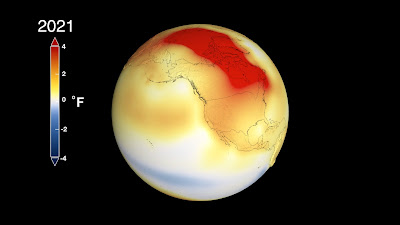
 On January 13, 2022 a coastal city in northwestern Australia recorded the hottest ever temperature it had ever seen. 123 degrees Fahrenheit (It tied one other event).A station in Onslow, a small coastal town in Western Australia, registered a sweltering 123.3 degrees (50.7 degrees Celsius) amid a severe heat wave. If verified, it would tie the all-time high reading set in Oodnadatta, Australia, on Jan. 2, 1960. In Mid-January, NASA and NOAA released their Annual Global Temperature analysis and determined that 2021 was tied for the 6th Warmest Year on the planet. (CLICK FOR THE RESEARCH) 


(image: This data visualization shows global surface temperature anomalies for 2021. Higher than normal temperatures, shown in red, can be seen in regions such as the Arctic. Lower than normal temperatures are shown in blue. Credits: NASA’s Scientific Visualization Studio/Lori Perkins)

Courtesy of NOAA and the World Meteorological Organization, from the Washington Post, here is a select list of verified and unverified national and international record-breaking temperatures (in recorded history) in the past two years:

  • World’s hottest year at 1.08 degrees (0.6 degrees Celsius) warmer than 1981-2010 average: 2020 tied with 2016
  • World’s hottest month at 1.67 degrees (0.93 degrees Celsius) above the 20th-century average: July 2021
  • World’s highest (and North America’s highest) reliable temperature at 129.9 degrees (54.4 degrees Celsius), at least since 1931: Death Valley, Calif., Aug. 16, 2020, and July 9, 2021
  • Arctic’s highest temperature at 100.4 degrees Fahrenheit(38 degrees Celsius): Verkhoyansk, Russia, June 20, 2020.
  • Antarctica’s coldest season with an average of minus-78 degrees Fahrenheit (minus-61 Celsius): 2021
  • Europe’s highest temperature at 119.8 degrees Fahrenheit (48.8 degrees Celsius): Syracuse, Italy, Aug. 11, 2021
  • Canada’s highest temperature at 121 degrees Fahrenheit (49.6 degrees Celsius): Lytton, B.C., June 29, 2021
  • Turkey’s highest temperature at 120.4 degrees Fahrenheit (49.1 degrees Celsius): Cizre, July 20, 2021
  • Spain’s highest temperature at 117 degrees Fahrenheit (47.4 degrees Celsius): Montoro, Aug. 14, 2021
  • Greece’s highest temperature at 115.3 degrees Fahrenheit (46.3 degrees Celsius): Makrakomi, Aug. 2, 2021
  • Paraguay’s highest temperature at 113.9 degrees Fahrenheit (45.5 degrees Celsius): Pozo Hondo, Sept. 26, 2020
  • Oman’s highest temperature at 124.9 degrees Fahrenheit (51.6 degrees Celsius): Joba, June 16, 2021
  • United Arab Emirates tied highest temperature at 125.2 degrees Fahrenheit (51.8 degrees Celsius): Sweihan, June 6, 2021
  • Iraq’s highest temperature at 125.2 degrees Fahrenheit (51.8 degrees Celsius): Baghdad, July 28, 2020
  • Cuba’s highest temperature at 102.7 degrees Fahrenheit (39.3 degrees Celsius): Veguitas, Aug. 11, 2020
  • Ghana’s highest temperature at 111.2 degrees Fahrenheit (44 degrees Celsius): Navrongo, April 6, 2020
  • Lebanon’s highest temperature at 113.7 degrees Fahrenheit (45.4 degrees Celsius): Houche Al Oumara, July 27, 2020
  • Contiguous United States’ warmest December with an average of 39.3 degrees Fahrenheit (4 degrees Celsius): 2021
  • NASA VIDEO: https://youtu.be/pLU8v8fAw7s

Who I am

I'm a simple guy who enjoys the simple things in life, especially our dogs. I volunteer for dog rescues, enjoy exercising, blogging, politics, helping friends and neighbors, participating in ghost investigations, coffee, weather, superheroes, comic books, mystery novels, traveling, 70s and 80s music, classic country music,writing books on ghosts and spirits, cooking simply and keeping in shape. You'll find tidbits of all of these things on this blog and more. EMAIL me at Rgutro@gmail.com - Rob

A Classic Country Music Station to Enjoy