|
| The large cloud of dust to our west! |
 |
| Some dust to our east covering the mountains |
In today's final AZ Trip blog, you'll learn about what to do if you run into a severe dust storm as we did on our way from Tucson to Phoenix. Suddenly an emergency alert buzzed on both Dan's and my cell phones indicating the dust storm. We noticed that it was far to the northwest of us and fortunately, we missed it! Learn what to do if you encounter one - Read on!
If you run into a severe dust storm, reduce the speed of your vehicle immediately and drive carefully off the highway. After you are off the paved portion of the roadway, turn off your vehicle's lights to ensure other cars do not follow you off the road and hit your vehicle. ... Reduce speed and turn on driving lights

NATIONAL WEATHER SERVICE ADVICE IF DRIVING DURING A DUST STORM ALERT
If dense dust is observed blowing across or approaching a roadway, pull your vehicle off the pavement as far as possible, stop, turn off lights, set the emergency brake, take your foot off of the brake pedal to be sure the tail lights are not illuminated. Don't enter the dust storm area if you can avoid it.
ARIZONA DEPT OF TRANSPORTATION TIPS IF ON THE ROAD
ADOT says the number one thing you can do during a dust storm is not driving at all, in a recent release, the department offered the following suggestions for those on the road:
 - If you're in a dust storm, check traffic around your car and begin slowing down immediately.
- Safely pull off the roadway as soon as possible. Don't wait until it's too late and visibility is poor. Drivers should completely exit the highway if possible.
- Avoid stopping in a travel or emergency lane. Try to find a safe place to pull all the way off the paved portion of the roadway.
- Once you're pulled over, turn off all vehicle lights. This will help keep other vehicles approaching from behind from using your lights as a guide and possibly crash into your parked car.
- Put on your emergency brake and then take your foot off the brake.
- As you wait for the storm to pass, stay in your car with your seat belt buckled.
- If you're driving a high-profile vehicle, you should be aware of changing weather conditions and drive at lower speeds.
- If you're in a dust storm, check traffic around your car and begin slowing down immediately.
- Safely pull off the roadway as soon as possible. Don't wait until it's too late and visibility is poor. Drivers should completely exit the highway if possible.
- Avoid stopping in a travel or emergency lane. Try to find a safe place to pull all the way off the paved portion of the roadway.
- Once you're pulled over, turn off all vehicle lights. This will help keep other vehicles approaching from behind from using your lights as a guide and possibly crash into your parked car.
- Put on your emergency brake and then take your foot off the brake.
- As you wait for the storm to pass, stay in your car with your seat belt buckled.
- If you're driving a high-profile vehicle, you should be aware of changing weather conditions and drive at lower speeds.
*********************************
THAT'S ALL FOLKS - This marks the end of the Arizona trip blogs. Hope you've enjoyed the tour of southern Arizona. Now back to the regular mayhem.
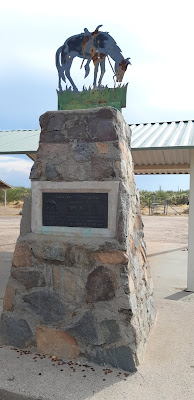 In today's blog about my Arizona trip, you'll learn about the western film actor, Tom Mix and the tragic accident that took his life. After we left the Biosphere 2 complex, we drove north toward Phoenix. While on the highway we spotted a marker about Tom Mix, so we checked it out. You'll learn about it in today's blog.
 |
| Tom Mix |
HOW DID I KNOW OF TOM MIX? I only knew about Tom Mix, the 1940s western /cowboy actor because I have read a lot about Wyatt Earp's life. When Wyatt was in his 70s, he and his wife Josie moved to Los Angeles, California, and Wyatt hung around movie studios, and got to know Tom Mix! So, I learned about the actor.
History.com provided the following info:
WHO IS TOM MIX? The star was a genuine cowboy and swaggering hero of the Wild West: He was born in Texas; fought in the Spanish-American War, the Boxer Rebellion and the Boer War; and served as a sheriff in Kansas, a U.S. marshal in Oklahoma and a Texas Ranger. In fact, Mix was born in Driftwood, Pennsylvania; deserted the Army in 1902; and was a drum major in the Oklahoma Territorial Cavalry band when he went off to Hollywood in 1909. None of these inconvenient facts prevented Mix from becoming one of the greatest silent-film stars in history, however. Along with his famous horse Tony, Mix made 370 full-length Westerns. At the peak of his fame, he was the highest-paid actor in Hollywood, earning as much as $17,500 a week (about $218,000 today).
 |
Tom Mix's car -restored after crash
|
 DIFFICULTY TRANSITIONING INTO TALKING PICTURES - Unfortunately, Mix and Tony had a hard time making the transition to talking pictures. Some people say that the actor’s voice was so high-pitched that it undermined his macho cowboy image, but others argue that sound films simply had too much talking for Mix’s taste: He preferred wild action sequences to heartfelt conversation.
 |
| The Highway where Tom Mix's car crashed |
ABOUT THE ACCIDENT - On October 12, 1940, cowboy-movie star Tom Mix is killed when he loses control of his speeding Cord Phaeton convertible and rolls into a dry wash (now called the Tom Mix Wash) near Florence, Arizona. He was 60 years old. On the day he died, Mix was driving north from Tucson in his beloved bright-yellow Cord Phaeton sports car. He was driving so fast that he didn’t notice–or failed to heed–signs warning that one of the bridges was out on the road ahead. The Phaeton swung into a gully and Mix was smacked in the back of the head by one of the heavy aluminum suitcases he was carrying in the convertible’s backseat. The impact broke the actor’s neck and he died almost instantly. Today, the dented “Suitcase of Death” is the featured attraction at the Tom Mix Museum in Dewey, Oklahoma.
HIGHWAY MEMORIAL - Today, visitors to the site of the accident can see a 2-foot–tall iron statue of a riderless horse and a somewhat awkwardly written plaque that reads: “In memory of Tom Mix whose spirit left his body on this spot and whose characterization and portrayals in life served to better fix memories of the Old West in the minds of living men.”
NEXT: FINAL AZ BLOG: Severe Dust Storm Imminent!
 |
| The Giant "Lung" underneath the Biosphere |
Last week I toured you through the biosphere in the Arizona desert. Today, we'll take you to the underground part of the biosphere, where you'll learn about the famous giant "Lung" and the oxygen challenge...
Read on!
 |
| Rob and Dan descending into the Biosphere's "Lung" |
WHAT IS THE BIOSPHERE 2? As a reminder, here's the summary of the biosphere: It remains the largest closed system ever created. Biosphere 2 was originally meant to demonstrate the viability of closed ecological systems to support and maintain human life in outer space. ... Its mission was a two-year closure experiment with a crew of eight humans ("biospherians"). The self-contained and sustainable environment (that would simulate what it's like living on another planet in a domed in environment.
 |
| Outside look that the windows and steel construction |
WHAT'S UNDERGROUND? - Below ground was an extensive part of the technical infrastructure. Heating and cooling water circulated through independent piping systems and passive solar input through the glass space frame panels covering most of the facility, and electrical power was supplied into Biosphere 2 from an onsite natural gas energy center.
 |
| Outside another part of the Biosphere - Many windows! |
THE GIANT "LUNG" - During the day, the heat from the sun caused the air inside to expand and during the night it cooled and contracted. To avoid having to deal with the huge forces that maintaining a constant volume would create, the structure had large diaphragms kept in domes called "lungs" or variable volume structures. LOOKS LIKE A TRAMPOLINE - The lung resembles a giant trampoline and it rises and descends based on the temperature and air pressure inside the Biosphere 2 environment above. It's fascinating to see.
 |
| The Santa Catalina Mountains |
 |
| Rob and Dan leaving Biosphere 2 |
THE OXYGEN CHALLENGE - There were several challenges to maintaining it as a habitable environment, and that included oxygen and CO2 levels. The oxygen inside the facility, which began at 20.9%, fell at a steady pace and after 16 months was down to 14.5%. This is equivalent to the oxygen availability at an elevation of 4,080 meters (13,390 ft). Since some biospherians were starting to have symptoms like sleep apnea and fatigue, Walford and the medical team decided to boost oxygen with injections in January and August 1993. The oxygen decline and minimal response of the crew indicated that changes in air pressure are what trigger human adaptation responses.
WHERE IS IT LOCATED? The glass and spaceframe facility is located in Oracle, Arizona at the base of the Santa Catalina Mountains, about 50 minutes north of Tucson. Its elevation is around 4,000 feet (1,200 m) above sea level.
NEXT FILM STAR TOM MIX'S FATAL CRASH SCENE
 |
| Rob and Dan listening to the Biosphere 2 tour |
In the last blog about my Arizona trip to visit our friend Dan, we started taking you through the Biosphere II. In today's blog we'll show you different parts of that self-sustaining environment in the desert of Arizona and explain the biomes.
WHAT IS BIOSPHERE 2? It's the size of about 2 football fields and is the largest closed system ever created! The sealed nature of the structure allowed scientists to monitor the continually changing chemistry of the air, water and soil contained within. Health of the human crew was monitored by a medical doctor inside and an outside medical team.
 |
| The Mangrove wetlands |
WHERE IS IT LOCATED? The glass facility is elevated nearly 4,000 feet above sea level at the base of the Santa Catalina Mountains in Arizona, near Tucson.
WHAT IS A BIOME? A biome /ˈbaɪoʊm/ is a community of plants and animals that have common characteristics for the environment they exist in. They can be found over a range of continents. Biomes are distinct biological communities that have formed in response to a shared physical climate.
WHAT ARE THE BIOMES INSIDE? There is a 1,900 square meter rainforest, an 850 square meter ocean with a coral reef, a 450 square meter mangrove wetlands, a 1,300 square meter savannah grassland, a 1,400 square meter fog desert, a 2,500 square meter agricultural system, a human habitat, and a below-ground level technical infrastructure.
HOW IT IS HEATED AND COOLED - Heating and cooling water circulated through independent piping systems and passive solar input through the glass space frame panels covering most of the facility, and electrical power was supplied into Biosphere 2 from an onsite natural gas energy center through airtight penetrations.
 |
| Growing plants |
 |
| The Ocean Biome and Coral Reef |
WHO MANAGES IT? On June 26, 2007, the University of Arizona announced that it took over management of Biosphere 2, using the site as a laboratory to study climate change, among other things.
NEXT: Going Underground in the Biosphere 2
 |
| The mangroves area |
 |
| Rob and Dan walking through Biosphere 2 |
In today's Arizona blog, (and we're nearing the last of them), we'll explore the Biosphere 2, out in the desert outside of Tucson, Arizona. Imagine being locked into an environment with 7 others for 2 years and trying to survive... in addition to work. That's exactly what happened when the Biosphere 2 was built. Read on!
 |
| Biosphere 2 |
WHAT IS BIOSPHERE 2? - Biosphere 2 was the largest completely sealed environment ever built. Its themed environments, or “biomes,” include living examples of the rainforest, the ocean, tropical wetlands, savannah grasslands, and a coastal fog desert. The original Biosphere is our own planet Earth.
WHAT IS THE BIOSPHERE 2? - Biosphere 2 is an American Earth system science research facility located in Oracle, Arizona. It was originally constructed between 1987 and 1991, and has been owned by the University of Arizona since 2011.
 |
| The 8 people who lived inside for 2 years |
WHAT WAS THE ORIGINAL PURPOSE? - A self-sustainable environment, that would mimic settlements on other planets. From 1991 to 1993, eight people were locked in the giant terrarium, Biosphere II, to live without physical contact with the outside world for two years
 |
| Dan at the entrance to the Biosphere |
WHAT IS IT USED FOR TODAY? - Its mission is to serve as a center for research, outreach, teaching, and lifelong learning about Earth, its living systems, and its place in the universe.
WHERE IS IT LOCATED? 32540 S Biosphere Rd, Oracle, AZ 85739
 |
| The only coffee plant inside |
COFFEE PLANT NON SO SUSTAINING - So the 8 people grew their own food during the time they were there. The one large coffee plant there was apparently not as sustaining as it could have been. It produced only enough coffee for 1 cup per 8 people every 2 weeks. I would never have volunteered for that project!!
NEXT -A Walk through the Biosphere
 |
| The TBM3 Aircraft |
In this final look at the Pima Air and Space Museum, it's a visual
guided tour of the interesting TBM3 Aircraft and some of the other aircraft... We also met a docent who
used to work for the military as an airplane mechanic. We talked with
him for a while and he gave us a good history of various world war 2 aircraft.
 WHAT IS THE TBM3 AIRCRAFT? - Manufactured by Northrop Grumman, even when carrying 2,000 pounds (908 kg)
of bombs or a single 22.7-inch aerial torpedo, the Avenger could reach a
speed of 271 miles per hour (433 km/h).
The Avenger’s pilot sat fairly far forward, almost perfectly aligned with the wing leading edge.
WHAT IS THE TBM3 AIRCRAFT? - Manufactured by Northrop Grumman, even when carrying 2,000 pounds (908 kg)
of bombs or a single 22.7-inch aerial torpedo, the Avenger could reach a
speed of 271 miles per hour (433 km/h).
The Avenger’s pilot sat fairly far forward, almost perfectly aligned with the wing leading edge.
 WHAT FAMOUS PILOT FLEW IT? This is the aircraft type which President George H.W. Bush flew in
WWII.
THE BERMUDA TRIANGLE CONNECTION - Five Avengers made up Flight 19, the aerial formation
which disappeared mysteriously over the Bermuda Triangle on December
5th, 1945.
WHAT FAMOUS PILOT FLEW IT? This is the aircraft type which President George H.W. Bush flew in
WWII.
THE BERMUDA TRIANGLE CONNECTION - Five Avengers made up Flight 19, the aerial formation
which disappeared mysteriously over the Bermuda Triangle on December
5th, 1945.
 FLOWN BY THE UK - The Royal Navy flew hundreds of Avengers in WWII, and initially named the TBF ‘Tarpon.'
NEXT: Onto Biosphere II in the Desert!
FLOWN BY THE UK - The Royal Navy flew hundreds of Avengers in WWII, and initially named the TBF ‘Tarpon.'
NEXT: Onto Biosphere II in the Desert!
 |
| Rob and a NASA aircraft |
In today's blog you'll see 2 NASA Aircraft and some of the Presidential aircraft housed at the Pima County Air and Space Museum in Tucson, Arizona!
 |
Aero Spacelines 377-SG Super Guppy
|
NASA AIRCRAFT- There were 3 NASA Aircraft at the museum and of course, I had to see those. Unfortunately, they were all the way at the end of the outside area, and the air temperature was 106F, so I ducked under wings of other aircraft for shade!
They included the Grumman Gulfstream I, the Super Guppy and a Boeing KC-135A Stratotanker.
WHAT IS THE NASA AEROSPACELINES 377-SG SUPER GUPPY? NASA used this plane inuntil 1991.
HOW BUILT? - Guppies were built from parts of retired U.S. Air Force C-97 Stratofreighters
 |
| Dan at the NASA Grumman Gulfstream I |
and airline 377 Stratocruisers.
WHAT WAS IT USED FOR? - It carried segments of rockets and much of the Saturn rocket that powered the Apollo Program was transported in the Super Guppy.!
PRESIDENTIAL AIRCRAFT- One of the aircraft was used by Presidents Kennedy and Johnson from 1961 to 1965.
 |
| Presidential Aircraft |
 |
| The VC-118A Liftmaster |
WHAT IS THE DOUGLAS VC-118A LIFTMASTER? - The C-118 is a militarized version of the Douglas DC-6 airliner. Just
over 100 C-118s were acquired for use by the Air Force as passenger and
cargo transports. The main difference between the military and civil
versions is the installation of a large cargo door on the left side of
the aircraft. The C-118s were used primarily as passenger aircraft and
several eventually served in the Presidential fleet. This aircraft
served as the official Air Force One for President Kennedy. It was the
last propeller driven aircraft to be designated as the primary
Presidential transport.
NEXT: A LOOK AT SOME OTHER AIRCRAFT
 |
| Dreamliner |
In today's blog, we'll tell you about a commercial airline graveyard that we stumbled up in southern
Arizona. It's called the Pinal Airpark Airport. It was a thrill for
Dan, because he is an airplane enthusiast and knows hundreds of
aircraft. We pulled off the Interstate 10 highway and were able to see
some dismantled planes on the other side of a chained link fence. You'll
learn about why its there and what's there!
WHERE IS THE AIRPARK? -- The Pinal Airpark Airport, located in Marana, Arizona, northwest of Tucson, is a county-owned airport just north of the Pinal/Pima county line along Interstate 10. It was originally known Marana Army Air Field.
WHO WORKS THERE? - On the grounds of the airport are a variety of tenants, both private sector and government.
THE AIRCRAFT "BONEYARD" - One primary function is serving as a "boneyard" for civilian commercial aircraft as well as airliner storage, reconfiguration, and reclamation. Out-of-service airliners are stored there since the dry, low humidity of the Sonoran desert provides an ideal storage environment.

THE DREAMLINER - Dan was fascinated with the "Dreamliner" aircraft, and explained to me the significance. He told me the Boeing 787 Dreamliner or Boeing 787 is an American long-haul,
mid-size wide-body, twin-engine jet airliner manufactured by Boeing
Commercial Airplanes. Its variants seat 242 to 330 passengers in typical
two-class seating configurations.
WHAT WAS SPECIAL ABOUT THE DREAMLINER? - The cabin pressure on the 787
is higher and the humidity higher than other airplanes. Basically,
passengers on board will feel like they are at an altitude of 6,000
feet, 2,000 feet lower than a standard flight. The changes will cut down
on passenger fatigue, dry eyes and headaches, Boeing said.
FAMOUS ARRIVAL AT THE AIRPARK - Pinal Airpark has been in the news in early 2018, with the arrival of the last Boeing 747 from Delta Air Lines. (see videos below on this page covering the final flight, and final flyover at Marana). It joined other 747s and airliners from Delta and a variety of other airlines for storage and reclamation. About 38 Delta airliners are parked at Pinal, including most of Delta’s fleet of retired Boeing 747s.
 THE CIA TOOK IT OVER FOR A WHILE - During the Vietnam War, the airfield was dominated by the Central
Intelligence Agency (CIA), and used as one of the Agency's primary
facilities for global covert air operations. A number of CIA false
"front" aviation companies operated there, including Intermountain
Airlines. "Air America" had its roots at Marana.
WHO MANAGES IT TODAY? - Today, the Pinal County Airport Economic Development Department
is responsible for the development and management of two airports in
the County. San Manuel Airport is a General Aviation Airport that is
located in the town of San Manuel. Pinal Airpark is a reliever airport
whose main tenant performs A&P service on aircraft for a multitude
of customers, as well as aircraft storage.
NEXT: THE PIMA COUNTY AIRPLANE AND SPACE MUSEUM
THE CIA TOOK IT OVER FOR A WHILE - During the Vietnam War, the airfield was dominated by the Central
Intelligence Agency (CIA), and used as one of the Agency's primary
facilities for global covert air operations. A number of CIA false
"front" aviation companies operated there, including Intermountain
Airlines. "Air America" had its roots at Marana.
WHO MANAGES IT TODAY? - Today, the Pinal County Airport Economic Development Department
is responsible for the development and management of two airports in
the County. San Manuel Airport is a General Aviation Airport that is
located in the town of San Manuel. Pinal Airpark is a reliever airport
whose main tenant performs A&P service on aircraft for a multitude
of customers, as well as aircraft storage.
NEXT: THE PIMA COUNTY AIRPLANE AND SPACE MUSEUM
 |
| Rob and Dan enjoy a sasparilla |
In today's blog we're close to wrapping up our visit to the amazing southern Arizona town
called Tombstone. Today we'll tell you about a sarsaparilla tradition that Dan started and show you the courthouse... which is a place that I had an odd remembrance of the first time I visited.
WHAT IS SARSAPARILLA? - Sarsaparilla is a
carbonated soft drink originally made from the native Central American
plant smilax ornata. ... Associated with the Old West, sarsaparilla was popular in the United States in the 19th century. Sarsaparilla is now generally made with artificial flavors and is considered a type of root beer.
The one time Dan visited Tombstone was a brief stop into a saloon to have a sarsaparilla, so we thought it a fitting way to wrap up our time there... and that's what we did. I've never tasted sarsaparilla before, and it was pretty good!
MY 1993 VISIT ODD EXPERIENCE- I realized I previously lived in Tombstone in the 1880s in a past life when I visited Tombstone for the first time. I remember just arriving in town and someone asked me where the court house was located. I told them to walk 2 block and turn left down the street and it was 2 blocks down. There was no way I could have known that because I just came into town, yet I gave someone directions! I remember walking the way I directed the person, and sure enough, that's exactly where the courthouse was located!
So, we walked back to the courthouse to get a look at it.
 |
| A Tombstone street |
THE TOMBSTONE COURT HOUSE - Built in 1882 in the shape of a Roman cross, the two-story Victorian
structure once housed the offices of the sheriff, recorder, treasurer,
board of supervisors, jail, and courtrooms of Cochise County. Today, the
12,000 square foot courthouse is a museum filled with the glitter and
guns of those who tamed the territory.
 |
| The Tombstone court house |
Exhibits portray the authentic history of Tombstone as a frontier
silver mining boomtown. Learn about miners, cattlemen and pioneers, and
see a reproduction of the courtroom and sheriff’s office.Displays
include a tax license for operating a brothel and an invitation to a
hanging. A replica of the gallows in the courtyard represents where
seven men were hanged. Website: http://tombstonecourthouse.com/
 SUNSET - I will say that Arizona had some spectacular sunsets. There's a picture of one below from our hotel window in Tombstone.
 NEXT: The Pinal Airpark Graveyard
 In today's blog we'll take you on a short tour of Tombstone's Epitaph newspaper, that's been around since 1880!! The newspaper reported on the famous "Shootout at the O.K. Corral" on Oct. 26, 1881. The building that the newspaper was printed in is also now a museum. We'll also tell you about John Clum, the founder of the newspaper.
ABOUT THE PAPER - The Tombstone Epitaph is a Tombstone, Arizona-based monthly publication that serves as a window in the history and culture of the Old West. Founded in January 1880, The Epitaph is the oldest continually published newspaper in Arizona.
In today's blog we'll take you on a short tour of Tombstone's Epitaph newspaper, that's been around since 1880!! The newspaper reported on the famous "Shootout at the O.K. Corral" on Oct. 26, 1881. The building that the newspaper was printed in is also now a museum. We'll also tell you about John Clum, the founder of the newspaper.
ABOUT THE PAPER - The Tombstone Epitaph is a Tombstone, Arizona-based monthly publication that serves as a window in the history and culture of the Old West. Founded in January 1880, The Epitaph is the oldest continually published newspaper in Arizona.
 TODAY'S PAPER - The Epitaph has been a leading voice documenting the rich history of the American West. Today, The Tombstone Epitaph National Edition brings you monthly stories of outlaws and lawmen, soldiers and Indians, ranchers and townspeople...of inventions, intrigues, frontier cookery, Western humor, and Western travel. A fabulous gift for the Old West enthusiast and a souvenir of Tombstone that lasts all year.

 WHAT IS AN INTERTYPE MACHINE? - We saw an Intertype machine in the museum! - The Intertype machine incorporates a keyboard, a magazine that contains continuously reused type matrices, a casting mechanism, and a distribution system for returning used matrices to the magazine.
 |
| Blocked for stamping |
 |
| An aged Wyatt Ear (L) and John Clum (R) in 1900 |
JOHN CLUM, FOUNDER OF THE EPITATH - There was 1 man who started the newspaper: John Clum.
John Clum was an Easterner who had come West in the 1870s, looking for opportunities - like so many others. Experience as a meteorologist, Apache agent, lawyer, and newspaperman prepared him for the biggest challenge yet: Tombstone, Arizona Territory, where he arrived in January 1880.
Within five months, on May 1, 1880, Clum had started a newspaper in the silver boom town. "No Tombstone is complete without its epitaph," he proclaimed in the initial issue, giving the publication its distinctive name which lasts to this day.
Tombstone was torn politically, socially, and economically. Clum and The Epitaph were Republican, representing business and town interests. The newspaperman was elected mayor in 1881; he also served as postmaster and head of the local vigilance committee. Source: Tombstone Epitath
Since 1880, when The Tombstone Epitaph ® first reported on Wyatt Earp, Doc Holliday, and the Gunfight at the O.K. Corral ®,
FOR INFO: www.tombstoneepitaph.com
NEXT: THE COURTHOUSE AND A SARSAPARILLA
 |
| Re-enactors: L to R: Wyatt, Virgil, tourist, Morgan, Doc Holliday |
In today's blog about my Arizona September trip to visit our friend Dan, we explored the rest of the town of Tombstone. In today's blog you'll learn about the famous shootout NEAR the O.K. Corral (it happened in an alley next to the corral), and the Earps and Doc Holliday vs. the "Cowboys." In fact, there are several groups of actors that perform it daily. We saw the version at the O.K. Corral itself, which still stands from the 1880s. In today's blog you'll see pictures from that re-enactment and read about the history behind the event that even made the New York Times in 1881. Read on! >>>
WHAT WAS THE OK CORRAL? The O.K. in O.K. Corral stands for Old Kindersley, apparently the owner's name. It was a livery and horse corral from 1879 to about 1888.
I'M A WYATT EARP ADMIRER-
Most people don't know this about me, but in the early 1990s I became
fascinated with Wyatt Earp. He was a lawman who never used a gun to
disarm criminals and threatening situations. To me, he was a hero before
superheroes. (Sure he ran the Oriental Saloon gambling, but gambling
was a profession). I actually went to cities around the U.S. where he
lived and tracked down his history in each, from Kansas City, KS to Salt
Lake City, UT to Tombstone, AZ.
 |
| the handsome actor portraying Wyatt Earp |
ABOUT THE SHOOTOUT - The Gunfight at the O.K. Corral was a 30-second shootout between
lawmen and members of a loosely organized group of outlaws called the
Cowboys that took place at about 3:00 p.m. on Wednesday, October 26,
1881.
As I
mentioned in a previous blog, the Cowboys were cattle rustlers, thieves
and murderers. The Earps were the law in Tombstone. Virgil was the town
Marshall. He deputized his brothers Wyatt and Morgan and Doc John
Holliday (gambler, dentist, gunfighters) as special policemen. When the cowboys threatened the lives of the Earps over and over again, it finally came down to this event.
WHICH COWBOYS DIED? Billy Clanton, Tom and Frank McLaury died from wounds during the shootout.
 |
| re-enacting the shootout of Oct 26, 1881 |
 |
| actual location of the shootout, next to Fly's studio |
WHICH COWBOYS SURVIVED? - Ike Clanton, Billy
Claiborne, and Wes Fuller were the only Cowboys who came out of the
fight alive – and that was because they ran for their lives. Ike, one of the biggest troublemakers, ran like a coward after making the initial threats. He was later killed while attempting to rob someone (served him right).
FAST FACT - Tombstone is also called "The Town too tough to die." That's because in 1887 an earthquake in Mexico ruptured some underground aquifers and flooded the silver mines. The mines from that age remain flooded today.
NEXT: WHO WAS C.S. FLY AND WHY WAS HE FAMOUS?
Who I am
I'm a simple guy who enjoys the simple things in life, especially our dogs. I volunteer for dog rescues, enjoy exercising, blogging, politics, helping friends and neighbors, participating in ghost investigations, coffee, weather, superheroes, comic books, mystery novels, traveling, 70s and 80s music, classic country music,writing books on ghosts and spirits, cooking simply and keeping in shape. You'll find tidbits of all of these things on this blog and more. EMAIL me at Rgutro@gmail.com - Rob
A Classic Country Music Station to Enjoy


 - If you're in a dust storm, check traffic around your car and begin slowing down immediately.