Thursday, July 18, 2013

UK Trip #21: York Minster- Top View, Going Down Video, Ghost Story

You can see the "York Eye" ferris wheel!
 In the last blog, I shared the history of the famous York Minster Cathedral and our adventure climbing to the top of it to see the spectacular view of York, England. Today's blog features pictures and video from the top, and a video of what it was like to descend that narrow, winding, unventilated, claustrophobic stairway. I've also tossed in a ghost story for you.

THE VIEWS FROM THE TOP - I managed to regulate my breathing and keep my asthma in check by counting the stairs and maintaining a pace, so I was able to get to the top without much panting!
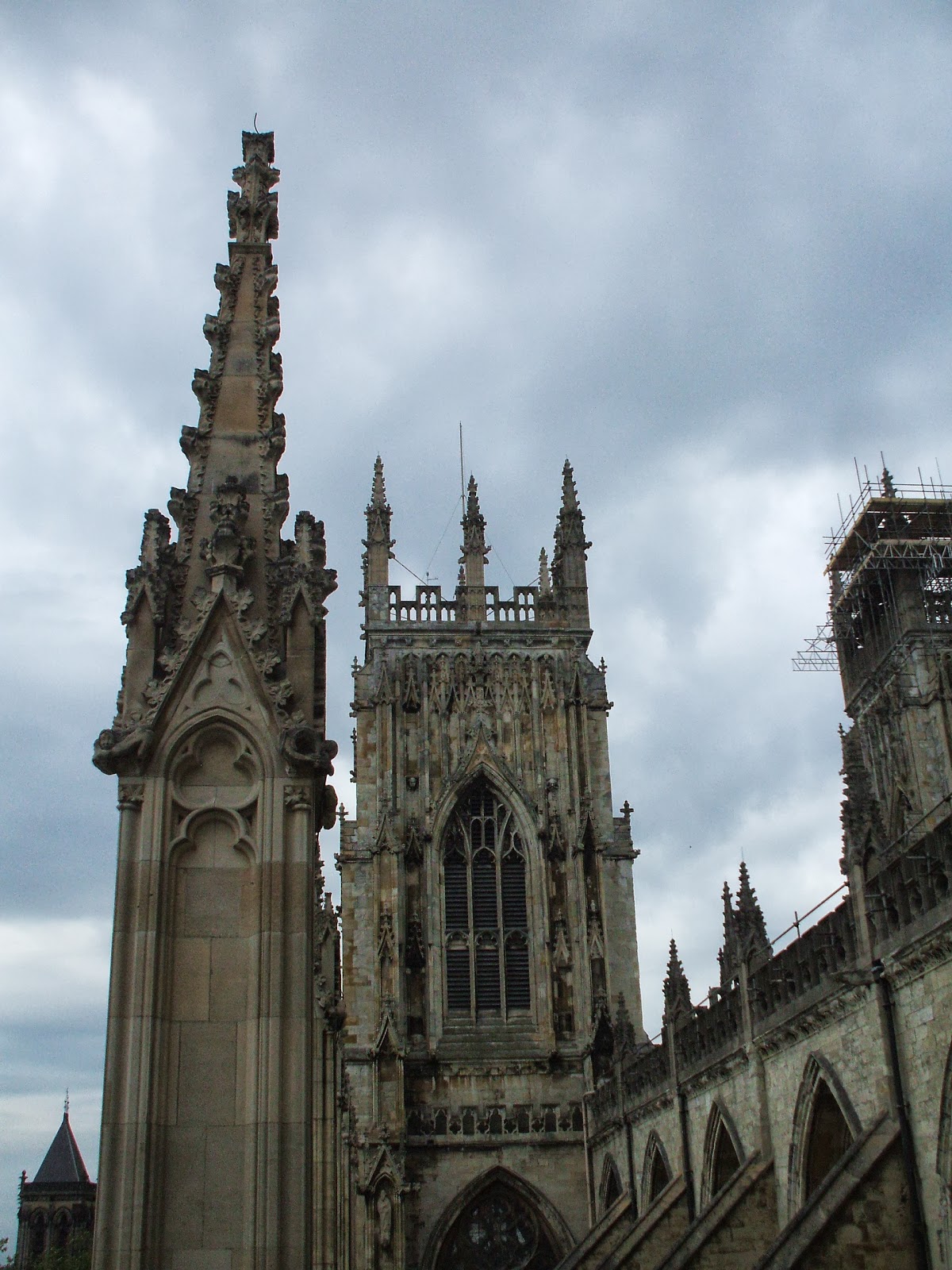
  The views from the top were amazing. The Minster is the highest structure in the City of York, and we were over 30 stories high. We took several pictures and a short video.


 THE YORK EYE - Just like London has an enclosed Ferris Wheel on the Thames, York does, too. We didn't ride on it, but we did see it from the roof of the York Minster.

CONSTRUCTION - We understood from one of the Minster docents that since the Cathedral was completed in the 1400s, it's really always been under repair. It was no surprise to see scaffolding on part of the church when we got to the top. The present building was begun in about 1230 and completed in 1472.
Some section is always under scaffolding and repair


The 2 trancepts


STAINED GLASS - York as a whole and particularly the Minster have a long tradition of creating beautiful stained glass. Some of the stained glass in York Minster dates back to the 12th century.

Rob, happy he made it with both lungs intact


Tom loved the view


TOWERS AND BELLS - The two west towers of the Minster hold bells, clock chimes and a "concert carillon."  I didn't know what that was, so in case you don't, its: An instrument  that consists of at least 23 cast bronze, cup-shaped bells, which are serially played to produce a melody, or sounded together to play a chord. A traditional manual carillon is played by striking a keyboard — the stick-like keys of which are sometimes called batons — with the fists, and by pressing the keys of a pedal keyboard with the feet. BTW- if you're German, you know it better as a " Glockenspiel."
   The north-west tower contains Great Peter (10.8 tons) and the six clock bells (the largest weighing just over 3 tons). The south-west tower holds 35 bells. The clock bells ring every quarter of an hour during the daytime and Great Peter strikes the hour.


HERE'S A VIDEO OF HOW IT IS TO DESCEND THE STAIRS: You may hear the guy with bad knees that was ahead of us as he struggled to go DOWN the stairs !
View from the first walkway going down


GHOSTS AT THE YORK MINSTER - According to the book "Haunted York" by Rupert Matthews (which I bought while in the town), there have been a couple of ghosts at the York Minster. One ghost was that of a stone mason that carved a piece of  stone work from the 1060s. In 1964 a woman had stopped outside the cathedral to admire the carving and a man walked up to her and asked if she liked the carving. Before she could respond, she said the man vanished into "thin air."

Another ghost story involves the spirit of a man who was the dean of the church. Dean Gale died in 1702 and was buried in the Minster. He always sat in the same seat in the front of the church. Six weeks after Gale's death Mr. Hawley was reading during the communion service, and stopped. He claimed that Dean Gale was sitting in the front row of the church, just as he always had. Several others who have read from the pulpit over time have also claimed to see Dean Gale sitting in the front row.


NEXT 2 BLOGS: A GREAT NEW GROUND-BREAKING VIDEO and A SPECIAL MESSAGE FROM SPRITE


Wednesday, July 17, 2013

UK Trip #20: Arrival in York, England: The Minster

The York Minster (a small part of it)
On Thursday, June 20, we departed Edinburgh, Scotland for York, England by train. Across the Pond Vacations picked a great hotel that was just one block from the train station, so we were able to walk there!  After a light breakfast we enjoyed the train ride (took several hours). Once we arrived in York, we took a cab to our hotel, unpacked and grabbed sandwiches from a "Booth Pharmacy" (they have good pre-made sandwiches and they're very affordable, too) and we sat outside under the cloudy sky people watching and eating in a shopping area.
   After walking around a bit through town we came across this famous cathedral. Tom was admiring the architecture, and wanted to venture inside. We would later venture to the roof, but I'll get to that.

WHAT IS THE YORK MINSTER?  York Minster is a cathedral in York, England, and is one of the largest of its kind in Northern Europe, according to Wikipedia. The minster is the seat of the Archbishop of York, the second-highest office of the Church of England and is the cathedral for the Diocese of York. It is run by a dean and chapter, under the Dean of York. The formal title of York Minster is "The Cathedral and Metropolitical Church of St Peter in York." 

WHAT'S "MINSTER" MEAN?  The title "minster" is attributed to churches established in the Anglo-Saxon period as missionary teaching churches, and serves now as an honorific title. Services in the minster are sometimes regarded as on the High Church or Anglo-Catholic end of the Anglican continuum.

HOW OLD IS IT? - The cathedral was started in the 1000s and finished in the 1200s, according to the literature we got there. It replaced an old Norman church from Roman times. The site was actually a Roman encampment and the cathedral was built on top of the Roman church. The Roman encampment dated back to 71 A.D.!  In the basement of the cathedral was an archeological display that showed some of the stones from the original Roman encampment. Very interesting. Roman fort ruins and Roman coins were actually excavated under the Cathedral. We also learned that Constantine stopped persecuting Christians and accepted their religion. (He could've kept proscuting the religious ultra-conservatives and that would be okay.)

Tom on the first walkway to the 2nd set of stairs
A DARING CLIMB TO THE TOP OF THE MINSTER - The cathedral offers a "climb to the top" for people who can make it. Of course, I (Rob) have asthma, but it's a once-in-a-lifetime thing, and Tom really wanted to make the climb, so I agreed. I just made him pay for it!  :)
  There are signs that say not to make the 257 rounded-stair climb if you have "Breathing problems, are very overweight, heart issues, bad knees, etc." That didn't stop the first couple who ran to the front of the line - the couple were as old or older than we are, and both man and woman were pretty overweight. SO, it was a slow climb with a number of stops along the way.
The first walkway to the second set of stairs
View of York from first walkway


There WAS  a break in the climb, though- which came after about 120 step, when we walked across a platform on the outside of the church to go to the SECOND set of stairs, which were about 137 steps to the rooftop.


ODORS IN SMALL AREAS -  Tom and I were the third couple in line making the climb while the rest of the group were behind us. Directly ahead of me (Rob) were a young couple from southeastern Asia. They could not have been older than in their early 20s. What struck me, though, was their rancid body odor. Fortunately, I only have about 20% of a sense of smell. However, their body odor was so pungent, and the stairs were in a tight enclosure with ZERO air circulation, that it hit me like a brick wall. Tom, who was climbing the stairs behind me was gasping when we got up to the first platform (after the first 120 stairs) and NOT because he was out of breath, it was because of the rancid odor coming from these two young people. We assume that it was because of something in their diet. Regardless, even the thinner air atop the cathedral was better than that in the narrow, stagnant stairway!


NEXT: THE YORK MINSTER: VIEWS FROM THE TOP, VIDEO GOING DOWN and a GHOST!

Tuesday, July 16, 2013

UK Trip #19: Read "Witchery Tales" - About Edinburgh, Scotland's Dark History

Earlier this month we took a trip to the U.K. that included Scotland. We  took the "Witchery Tour: Murder and Mayhem" in Edinburgh, Scotland (we blogged about it yesterday). There's a companion book to the tour that you can buy on-line and it's worthwhile. This book contains some of the stories told on the tour and gives you a great insight into the dark history of the city. 
   It's well-written and full of historic details about the city of Edinburgh. It really paints an interesting, yet dark history of the city's laws against thieves, murderers, and weird city laws.
ONE ODD HISTORIC FACT  FROM THE TOUR - Hundreds of years ago, Firemen were paid by clients that lived in apartment-like buildings. If the apartment above or below them was on fire, and those residents were not "firehouse subscribers," the firemen would let the building burn until it affected their client. Weird stuff! 
 - The Adam Lyal's Witchery Tour in Edinburgh, Scotland is a must for any visitor to the city, too. It was serious and funny, light-hearted and entertaining. This is a great read for anyone who wants a look at Scotland in the last several hundred years.

NEXT: ARRIVAL IN YORK, ENGLAND AND THE MINSTER

Monday, July 15, 2013

Rob is the "Cover Guy" of Bowie Life Magazine's First Issue!

Here's a surprise - Back in May I was contacted by the publisher of a new magazine called "Bowie Life Magazine" to write an article about my experiences with ghost hunting and the paranormal.  The debut issue came out this past Saturday- and features the article written by yours truly that includes lots of pictures.  It includes the Inspired Ghost Tracking Group and mediums Barb Mallon (www.barbmallon.com) and Ruthie Larkin (beantownmedium.com).
    - I must say that I was shocked that they put me on the cover, and used all the photos...but I'm pleased that we all got some great exposure.
 - I already heard from a college student that is interested in Inspired Ghost Tracking and I emailed him back.
 -  These were mailed to all the residents of the city, so I'm pretty excited about it!!
Here are the pages (starting with the cover) if you'd like to read it.


UK Trip #18: Enjoyed the"Witchery Tour" of Edinburgh, Scotland

Adam Lyle (deceased), our host
It's unusual to have a dead guy tour you through a town at night, pointing out the horrible histories, but that's what we got when we were in Edinburgh, Scotland.
  A tour guide of the "Witchery Tour" (www.witcherytours.com)  calls himself "Adam Lyle (deceased) and gave us an historically interesting, light-hearted, fun and memorable tour of downtown Edinburgh.
 I'll tell you who Adam Lyle was, shortly.
   Now, calling a "Witchery Tour" subtitled "Murder and Mayhem" fun may seem weird, but the guy who played Adam has a great sense of humor. He was dressed as a vampire, dark suit and cape, and his face and hair were bright white (makeup).
  He also had an assistant who would jump out along the tour from time to time, dressed as either a skeleton, mad monk or something else. It made for a couple of startling minutes, but good laughs afterward.
Edinburgh Writer's Museum

EDINBURGH WRITER'S MUSEUM - The first stop on our walking tour of murder and mayhem was at the Edinburgh's Writers' Museum. The museum is located off the Royal Mile (main street that connects Edinburgh Castle with Holyrood House Palace) in Lady Stair's Close. The building was built in 1622 as a private home for one of the city's wealthiest families.  The Museum hosts permanent exhibitions to three of Scotland's great literary figures, all of whom have strong Edinburgh connections: Robert Burns (1759 - 1796), Sir Walter Scott (1771 - 1832) and Robert Louis Stevenson (1850 - 1894).
 **The Museum is said to have a figure that appears in one of the upper windows.**


Cow's gate in Edinburgh, Scotland

The Mad Monk About to Run Toward Us!
THE GLOOMY COWGATE - We walked down a gloomy part of Edinburgh, on a street called "Cowgate"? The street's name was recorded as far back as1428, in various spellings, as Cowgate and in 1498 as Via Vaccarum. It is derived from the medieval practice of herding cattle down the street on market days; a number of other streets in the old town of Edinburgh (such as Grassmarket and Lawnmarket) also reflect their market roots. Gate is a Scots language word for "way" or "road."
   Between the mid 18th and mid 20th centuries the Cowgate was a poor, often overcrowded  slum area. In the 19th century, nicknamed "Little Ireland," it was home to much of the city's Irish immigrant community.
   It was here that the "Mad Monk" ran out from behind a building and 
ran toward our group, scaring the heck out of everyone! 

 
The Mad Monk and Adam Lyle Team Up


WHO WAS ADAM LYLE? - Adam Lyle (1785 – 1811)
was a highwayman that  reached the peak of his career by stealing over £126 (pounds) from a merchant on the road to Stirling. Unfortunately for him he was soon caught, after buying an extremely expensive pair of shoes. He was hanged on March 27,1811, in the Grassmarket, Edinburgh. It is believed that he still nightly haunts the Old Town’s closes and courtyards, terrifying locals and tourists alike.
WHO IS THE MAD MONK OF THE COWGATE? - For hundreds of years the Cowgate was home to many monasteries. However, in the mid-1600s, part of Blackfriars monastery was mysteriously burned to the ground. The ghost of one of the monks, terribly burned and utterly insane, is said to haunt the Cowgate to this day.  While some speculate that this tragic spirit is attempting to find his long-lost home, others claim that he is merely trying to get into one of the many pubs which later came to replace it…

The Australian family looking for the Mad Monk!

 THE MAD MONK RUNS UP AN ALLEYWAY
   The Mad Monk followed us up a small alleyway, called a "close" because the buildings were close to each other.
   You can see by the picture here how close the buildings were to each other. That's the way the old city was built. Because of these high buildings, the city tended to be very dark.
  As Adam Lyle led our group up the close, the Mad Monk ran up behind us!
   The only ones on the tour with us were a family of three from Australia- a mom, dad and teenage girl who was scared silly. 
  The Mad Monk sprayed us with water at one point, too, after he disappeared and re-appeared later (and again, startled everyone). It was a lot of laughs because we never knew where he'd show up.

ONE OF THE STORIES:  Agnes Fynnie died in 1641. She was an ill-tempered, foul-mouthed fishwife, who abused and cursed the locals whenever they refused to buy her wares. In fact, she was so disliked that she was accused of witchcraft, and managed to attract the largest number of charges in Scottish history (legend has it that this was the only thing she ever attracted). She was worryitt (strangled and burned) in 1641, on the Castlehill, but it is claimed that she can still be heard, venting her wrath on passers-by...

 
This was a great tour and we highly recommend it!  For more info, it's called The Cadies and Witchery Tours  www.witcherytours.com/‎ 
 
L to R: Mad Monk, Tom, Adam Lyle and Rob


Sunday, July 14, 2013

UK Trip #17: Scotland's Famous Dog: Greyfriar's Bobby

Tom and the statue of "Bobby"
   One of our favorite attractions in Edinburgh, Scotland involved a dog (no surprise there). As we walked up and down the "Royal Mile" we kept seeing postcards with a statue of a little dog and wondered what it was about. So, we asked someone and were directed to a graveyard. 
 
Greyfriars Bobby was a Skye Terrier who became known in 19th-century Edinburgh for supposedly spending 14 years guarding the grave of his owner until he died himself on January 14, 1872.

THE STORY OF GREYFRIAR'S BOBBY:
The best known version of the story is that Bobby belonged to John Gray, a nightt watchman for the Edinburgh City Police. John Gray died after only having Bobby for 2 years, but the dog had bonded to his master. John Gray was buried in Greyfriars Kirkyard, the graveyard surrounding Greyfriars Kirk in the Old Town of Edinburgh. Bobby, immediately homeless, became known locally, spending the rest of his life sitting on his master's grave where townspeople would feed him. 


"Bobby" and Robby :)
Nearby pub called the "Greyfriar's Bobby"
In 1867, Lord Provost of Edinburgh, Sir William Chambers — who was also a director of the Scottish Society for the Prevention of Cruelty to Animals — paid for Bobby's city dog license, and gave the dog a collar which is now in the Museum of Edinburgh.
   Bobby is said to have sat by the grave for 14 years.  Bobby died in 1872  and was buried just inside the gate of Greyfriars Kirkyard, not far from John Gray's grave (because local ordinances didn't allow pets to be buried in the same cemeteries as people. The ordinance said it was because it was "sacred ground" - what a lot of hooey.)


Bobby's tombstone, about 100 feet from his master's

STATUE TO GREYFRIAR'S BOBBY
A life-sized statue of Greyfriars Bobby was created by William Brodie in 1872. This was paid for by a local aristocrat, Baroness Burdett-Coutts and unveiled on November 15, 1873. It stands near the south (main) entrance to Greyfriars Kirkyard, at the southern end of the George IV Bridge. The monument is Edinburgh's smallest listed building! 


A plaque on the statue reads "A TRIBUTE TO THE AFFECTIONATE FIDELITY OF GREYFRIAR'S BOBBY. IN 1858, THIS FAITHFUL DOG FOLLOWED THE REMAINS OF HIS MASTER TO GREYFRIAR'S CHURCHYARD AND LINGERED NEAR THE SPOT UNTIL HIS DEATH IN 1872 WITH PERMISSION, ERECTED BY THE BARONESS BURDETT- COUTTS" and on the statue is written "GREYFRIAR'S BOBBY, FROM THE LIFE JUST BEFORE HIS DEATH" and "W.H. Brodie Sc RSA 1872


tombstone of John Gray, Bobby's master

Although we didn't know it at the time, several books and films have since been based on Bobby's life, including the novel Greyfriar's Bobby (1912) by Eleanor Atkinson and the films Greyfriars Bobby (1961) and The Adventures of Greyfriars Bobby (2006).

That's one dog we'll remember for a long time, just like the people of Edinburgh have. 

Saturday, July 13, 2013

Our Dog Sprite's Ashes Now Displayed

This morning, July 13, we picked up Sprite's ashes at our veterinarian's office. They provided them in a very nice wooden box with a carved floral design on the top. We had to run some more errands, so we put Sprite's ashes/box on the backseat comforter of the truck, where he usually sat and "took him for a ride."
  When we returned home, we went into our TV room/home office and put them in their resting place. We laid down Sprite's dark-colored blanket/throw  on top of the short bookcase. In late November 2010, Sprite came to us with just that blanket, and it remained his favorite. We used to put it on top of his bed, so he was always used to sleeping on top of it.
  So, we made sure that he would still be "sleeping on top of it" by placing it under his ashes, with a picture that we just enlarged and a new frame we bought today. Next to Sprite's ashes is my (Rob's) first dog, Buzz Wyatt, a Weimaraner who passed as a puppy in February 2005 (10 months before Tom and I met). We bought a new frame for his picture as well. Between the two boxes of ashes are Buzz's two favorite toys: a gorilla and a badger. Sprite never played with toys (apparently he didn't have any growing up, and when we took him in at 14 years old, he wasn't sure what to do with them, so never played with any).
  Now Sprite and Buzz are playing together "on the other side" and resting together on this side - in our house and with our family.

UK Trip #16: A Good Book About "Scotland's Ghastly Ghosts"

by Charles Sinclair
(Our TRIP BLOG will resume tomorrow)
  Today, I'm taking time to review a book about "SCOTLAND'S GHASTLY GHOSTS" that I read after we toured Edinburgh, Scotland. Anyone interested in the paranormal and the U.K. will want to read this book.
   Edinburgh, Scotland is a very haunted city where a lot of executions and killings occurred especially from the 1100s when the town was first settled. There were also rampant bouts of disease, disgustingly unsanity conditions, a large population in a small area and a lot of thievery. There were a lot of unsettled souls in the country, and that was conveyed in a book I bought and read while on vacation there called "Scotland's Ghastly Ghosts"  by Charles Sinclair.
    Sinclair takes the reader to castles and cityscapes that includes the "Headless Horseman of MacLains," the "Ghostly Drummer of Cortachy Castle," a scorching kiss from a female ghost of Meggernie, and a phantom cannonball that seems to smash through a window over and over bringing bad news for the living. There are other stories, too, of a man that murdered his wife and hid her body in in 2 pieces, in a castle that she now haunts (in pieces); and the ghosts in the  underground vaults of the city of Edinburgh.
  The book is full of interesting and quite startling stories of hauntings in Scotland. It's well worth reading, especially if you plan on ever visiting.  - Rob


   STORY OF THE GHOSTLY, DEADLY DRUMMER OF CORTACHY CASTLE
(Source: http://haunted-scotland.co.uk/cortachy-castle/)(Edited by R.Gutro)

Paranormal Phenomena : This is a story of a ghostly drummer at Cortachy Castle that is heard drumming when a member of the Ogilvy family is to die at the castle. According to Haunted Scotland.Co.UK, in folklore, the drummer boy betrayed the Ogilvys by failing to warn them of an approaching enemy force. He suffered their revenge by being thrown from the battlements inside his drum.
Cortachy Castle. Cr: haunted-scotland.co.uk
   The story begins at Christmas, 1844 when a a guest named Miss Dalrymple heard the beating of a drum as she dressed for dinner. During dinner she questioned Lord and Lady Airlie, her hosts, about the identity of the drummer. The Lord and Lady Airlie told Miss Dalrymple that the last time the drummer was heard, the first Lady Airlie died shortly after.
   Miss Dalrymple heard the drummer again the next morning and fled the castle. Within six months, Lady Airlie died apparently by suicide out of fear that the Drummer was drumming for her.
   Five years later on August 19, 1849 the drummer visited Englishman in a shooting party. The male visitor questioned several people about the drumming, but everyone denied hearing anything. However he was told that the 9th Earl of Airlie had become seriously ill requiring Lord Ogilvy’s presence. The Earl died the next day.
   It wasn't until 1881, 32 years later, that Lady Dalkeith and Lady Skelmersdale both heard the drummer at the same time. That same night, in America, Lord Airlie died. The family were later to learn that the sound of the drum was heard exactly one hour before his death.

Friday, July 12, 2013

UK Trip #15: Greyfriars Kirkyard Cemetery and a Vicious Ghost

   While touring Edinburgh, we kept seeing post cards with pictures of a dog statue in the local shops. Of course with us being dog lovers, our curiosity was piqued to find out what the story behind the statue was all about. So we queried one of the locals about the statue and learned that the little dog, dubbed "Greyfriars Bobby," was well loved by the city's residents and buried in Greyfriars Cemetery. Wanting to know more, we located the cemetery on a map and decided to go there. More on Greyfriars Bobby in the next blog.
 Greyfriars Kirkyard and Edinburgh Castle
   Greyfriars Kirkyard, or cemetery, is located at the southern edge of the Old Town. Burials have been taking place on the site since the late 16th century. The name "Greyfriars" originates from the Franciscan friary once located on the site, but dissolved in 1559. The graveyard was founded in 1561-2, to replace the cemetery at St Giles, which had been filled.

  From the book "The Ghost That Haunted Itself" by Jan-Andrew Henderson, we learned that the cemetery inspired an amazing array of famous authors to write their classic horror novels.
  A CHRISTMAS CAROL - In 1841, Charles Dickens visited the cemetery and mis-read the engraving on the tombstone of "Scroggie", which led to the naming of "Ebenezer Scrooge" in his famous story.
  DR. JEKYLL AND MR. HYDE - Robert Louis Stevenson visited the cemetery often, which accounts for the inspiration of many of his stories, including "Dr. Jekyll and Mr. Hyde."
  DRACULA - Bram Stoker visited the cemetery during the writing of his famous novel about the famous vampire.
  FRANKENSTEIN - Mary Shelley was on her honeymoon in Edinburgh during the time when corpses were being stolen from city's graveyards and being delivered to the local medical schools and universities for practice autopsies. Soon after her visit she penned her famous novel "Frankenstein."

SCOTLAND'S FAMOUS NASTY GHOST IN THAT GRAVEYARD - 
    I'm reading "The Ghost That Haunted Itself" and it's about a famous ghost they call the "McKenzie Poltergiest" that haunts that graveyard (although it's a ghost, not a poltergeist). McKenzie's ghost was re-awakened in 1999 when a homeless man invaded George McKenzie's crypt (buried in 1691) to find shelter. Since then McKenzie's ghost has caused many people on tours to black out, scratched them, blackened one of their eyes, brushed against them, pulled hair and more.       
      McKenzie was responsible for more than 1,800 deaths of people who were Presbyterian and wanted to keep their religion. Just before he died, the new king allowed for the people of Scotland to keep their Presbyterian faith and McKenzie was furious. Everything he murdered people for was now for nothing (he was trying to keep Scotland Catholic).
    Now his ghost haunts part of Greyfriars Cemetery and has been chained off so people can't get attacked by him anymore. We didn't know about it when we were there, and I wouldn't have ventured over. 
   The book says that 27 people fainted after feeling icy cold and being almost suffocated. Others walked away with bruises, black and blue marks or scratches on their bodies. A priest that did an exorcism in 2000 died not more than 2 months later, after reporting he was exhausted from the experience. Not a place to mess with. 
 
  THE BOOK SUMMARY: Greyfriar’s Cemetery in Edinburgh has a centuries-old reputation for being haunted. Its gruesome history includes witchcraft, body-snatching, desecration, corpse dumping, and live burial. In 1998, something new and inexplicable began occurring in the graveyard. Visitors encountered “cold spots,” strange smells, and banging noises. They found themselves overcome by nausea, or cut and bruised by something they couldn’t see. Over a period of two years, 24 people were knocked unconscious. Homes next to the graveyard were plagued by smashing crockery, moving objects, and unidentified laughter. Witnesses to these incidents ran into the hundreds. The section of Greyfriars where the attacks occurred is now chained shut, but the poltergeist still grows stronger.
 To order: http://www.amazon.com/The-Ghost-That-Haunted-Itself/dp/1840184825

NEXT: THE DOG WHO MADE THE CEMETERY  FAMOUS 

Thursday, July 11, 2013

UK Trip #14: The Scotch Whisky Experience and the Royal Mile

Walking the Royal Mile
TEA TIME - After we left the Holyrood House Palace, we stopped for afternoon tea and scones and was able to sit outside. It was odd that Edinburgh, Scotland would give us one of the only sunny days in our 9 day vacation, because the city is usually cloudy. The cafe was located on the Royal Mile.

Royal Mile Walking
WHAT'S THE ROYAL MILE? - The Royal Mile is the name given to a succession of streets forming the main thoroughfare of the Old Town of the city of Edinburgh in Scotland. It was first referred to the Royal Mile by W. M. Gilbert in his book called Edinburgh in the Nineteenth Century (1901). It runs one mile and covers the distance between Edinburgh Castle and Holyrood Palace. In front of Holyrood Palace is Parliament Square -  home of both the High Court of Justiciary and the Court of Session.


Tom and Rob at the Scotch Whisky Experience

Notice Rob's color is flush after sampling that whisky!

A whisky flask of Henry VIII and other tudor figures
THE SCOTCH WHISKY EXPERIENCE -  Although I (Rob) have never tasted whisky (they spell it without an "e") and Tom drinks occasionally, we decided to find out what was so special about Scotland's whisky, so we went to this attraction. The Scotch Whisky Experience begins by having people sit in a 2 person "seat-car" that moves through exhibit with video, audio and movement. It's a barrel ride through a replica distillery as you become part of the whisky making process. The website says "Along the way you’ll hear the stories behind this magical craft, with expert tour guides and whisky advisors. We’ll help you discover the aromas and flavours that appeal to your palate and lead you to your perfect Single Malt Whisky." -At the end of the ride they take you in a conference room with about 30 others and explain the 4 different "flavors' of Scottish whisky: Highland, lowland, Speyside and Islay. Then they pour some in a glass for you to test.
 - Tom got a "blended" whisky of all four kinds and I took the Highland, which to me tasted like what I would expect rubbing alcohol to taste like. It was Nasty!  Tom liked his, though, and tried mine and said "That's nasty!" I told him so!
  The Disney-like ride and display featuring short clips of an old time brewery manager from the 1800s made for a very entertaining visit, even if I thought the whisky was way too strong!     SHORT VIDEO - We made a short video in the room that housed the most whisky bottles ever in one room.


Wednesday, July 10, 2013

UK Trip #13 - Busking Bagpipers, Sandwiches and the Haunted Storefront

Busking bagpiper
Edinburgh, Scotland is an ancient town, and has a horrible history of murders, disease, and many deaths. Of course, there were also living bagpipers.
  Anyway, it's no surprise then, when we were walking that there were bound to be some people that died, and who were still lingering. One was in a store.

BAGPIPERS -  As we walked through Edinbugh, there were a couple of "Buskers" or street performers that were dressed in full scottish garb, kilt and all, playing the bagpipes. Here's a picture of one of them.

Entryway where the ghost was strongest
This Boots Pharmacy has a resident ghost
SANDWICHES - One thing we learned was a great way to save money on our trip (considering one U.S. dollar was worth about 60 pence or 60 percent of a British pound- so a dollar didn't go far), was to get pre-made sandwiches.  We learned quickly that drugstores and variety stores had really good pre-made sandwiches!   The sandwiches were nicely packaged, always fresh and between 1 pound 50 pence and 2 pounds 50 pence. Compared to getting one at a restaurant where sandwiches cost 5 pounds. That's about $8.00 dollars, U.S.  One of our favorite sandwiches were "chicken and bacon," and "chicken and sweet corn." They were really good!  We often got sandwiches like that and sat outside (usually it was cloudy and cool (only in the upper 50s, lower 60s Fahrenheit).

THE HAUNTED STOREFRONT - Because I (Rob) was still getting over the Shingles, my abilities to sense ghosts weren't working too well. It happens whenever you're sick or distracted. However, Tom sensed a ghost in the front doorway of the Boots pharmacy where we got our sandwiches. He smelled the "rotting corpse" smell that is associated with a ghost. I did get a little headache, too. ` We don't know if it's a male or female ghost, why they stayed behind or even what century they're from, but they "live" in the pharmacy.


Tuesday, July 9, 2013

Reflections of Sprite and Thanks

Tyler cuddles up to Sprite
Sprite loved his tee-shirts because he got cold
Sprite, Franklin, Tyler and Dolly 2012


Thanks to all for the messages and condolences about Sprite's passing yesterday. 


Our senior Dachshund, Sprite, was over 16 1/2 years old and was in failing health for the last couple of years. Last night, Sprite passed peacefully at the vet's office with Tom and I by his side. 
Read yesterday's Blog: Sprite: 12-23-96 to 7-8-13


Sprite July 8, 2013
Today, I just wanted to provide some more of our favorite pictures of Sprite over the 2 1/2 years that we were fortunate enough to have him and a few more special notes of thanks.  

Sprite, Franklin, Tyler and Dolly loved being together

He came to us in December 2010, less than a month before he turned 14. He was in poor health, but THANKS to Melissa Ball and Coast-to-Coast Dachshund Rescue (please donate if you can - they have a lot of dogs and cover their medical expenses: Coast-to-Coast Dachshund Rescue- donations), Sprite got a lot of great care while we had him as a foster dog.
Us with our kids (before Tyler arrived)
    In addition to being loved unconditionally here at home, Sprite had some special people in his life who loved and helped care for him.


SPECIAL THANKS FROM SPRITE:

Mom and Bob (Tom's parents) - who loved caring for Sprite whenever we took trips. They would always look forward to taking Sprite for long weekends or any time they could. They spoiled him all the time with his favorite soft treats and lots of hugs and walks. I remember many times talking on the phone with Bob about us going away and the first thing he said was "Can we take Sprite?"
Yolie - Our friend and neighbor lets our kids out if we have to be out an extended period of time, and has been a wonderful aunt to them. Yolie noted that this past week Sprite couldn't get out of bed when she came over, and she had to help him out - she knew it was his time, too.

Sprite, Franklin and Dolly loving the backyard
Elvina -Our friend and neighbor Elvina is a big dog lover, and had 4 Yorkies years ago. She always looks forward to our walks by her house so she can come outside and give all our kids some loving.

Thanks to all our friends and family - who have spoiled Sprite during his time with us (there are too many to name).

Melissa Ball - Our friend and coordinator of Coast-to-Coast Dachshund Rescue, thanks for allowing us to foster and adopt Sprite. He was the most obedient dachshund I've ever known, and just an old, gentle soul.
Sprite on his orthopedic bed with favorite blanket

Cuddling with Daddy Tom

Exploring

The kids hanging out with friend Cooper

Where's my pupperoni?

Cuddling with Tyler

Who I am

I'm a simple guy who enjoys the simple things in life, especially our dogs. I volunteer for dog rescues, enjoy exercising, blogging, politics, helping friends and neighbors, participating in ghost investigations, coffee, weather, superheroes, comic books, mystery novels, traveling, 70s and 80s music, classic country music,writing books on ghosts and spirits, cooking simply and keeping in shape. You'll find tidbits of all of these things on this blog and more. EMAIL me at Rgutro@gmail.com - Rob

A Classic Country Music Station to Enjoy