Showing posts with label Spain trip. Show all posts

Wednesday, August 15, 2018

Spain Blog #56: Seville's Alcazar: Part 2: Gardens, a Woven Dog, and Ghostly Energy

 In this blog on Alcazar Palace we'll show you some of our favorite pictures. There are just 4 of them so it won't take too long to enjoy them. But you'll read about the baths, ceilings, gardens, the Woven dog and ghostly energy! At the end of this blog, you'll find my observation of the palace tour over all. 

1) Tom at the Vaulted Underground Baths - this was a bathing chamber built under the palace. They're actually called the "The baths of Dona Maria of Padilla" and are located below the main palace 

2) Ornate Ceilings - In every room each ceiling had different designs on it. One of them looked as if it had huge flower patterns. 


3) The Gardens - The gardens are located at the very back of the palace. At the lower level of the palace are the Vaulted Underground Baths that open right into the gardens. 
   The palace gardens, continuously changed since the Renaissance with an outpouring of fountains and ponds, pavilions, arches and galleries. The parterres, have been constantly re-invented, and, right up until the mid-nineteenth century  

The name it was given is Jardin Inglés (English gardens) - These gardens are modeled on those of the British Isles from 18 Century. The park was built in 1909 and the main gardener of the Real Casa de Campo, Juan Gras, was put in charge of planting the flowers.  

4) The Woven Dog - There was one room filled with nothing but giant tapestries hanging on the walls. One that we showed you yesterday had an old map of Spain and the various kingdoms (we talked about those a couple of blogs back). The one that we both liked the best, however, had a dog on it (seen here). 

5) The Ghostly Energy! In the Palace's "Hall of Justice"  - This room was built by Alonso the XI in the 14th century. It was used as a courtroom by Pedro I.  
  As we entered the room, and not knowing what it was until after inside, I (Rob) suddenly experienced shaky legs and felt fright. 
   When I learned the purpose of this room, those emotions that I picked up from the residual energy in the room's walls, made perfect sense. People on trial in that room would feel those emotions and they radiated them into the structure.
   The energy was especially strong near the courtyard entrance. 

FINAL OBSERVATION  - Like the Alhambra Palace - this had NO furnishings to give visitors an idea of how people lived in these rooms at different times. It was disappointing.  Although the artwork on the ceilings and walls are ornate and beautiful, it's hard to understand how people lived in the palace over the last 1,000 years. 

NEXT: THE PLAZA DE ESPANA - A TRUE HIGHLIGHT

Thursday, August 9, 2018

Spain Blog #53: Seville: Climb to the Top of a Tower, and a Ghost!

Bells at the top of the Tower! 
In today's blog, you'll climb to the top of the tower in the Cathedral of Seville, where I (Rob) met a ghost with a tragic end. Every time we go on vacation, Tom likes to go to the highest point to take in the view (I admire that, but my asthma doesn't). You'll learn Fun Facts about the Cathedral and see the largest altarpiece in the World!! Anyway, come along and learn about the Cathedral, the Tower and the GHOST!


FUN FACTS ABOUT THE SEVILLE CATHEDRAL
1) The Seville Cathedral is one of the famous Roman Catholic cathedrals in Spain.  
Largest altarpiece in the world! 
2) Seville Cathedral is the third-largest church in the world as well as the largest Gothic church.  

3) Seville Cathedral has 15 doors on its four facades and each one features a unique relief or carving.
4) Built on the site of the great 12th-century Almohad mosque, Seville’s cathedral was built to demonstrate the city’s power and wealth.
5) The cathedral’s construction lasted over a century, from 1401 to 1506.
6) The total area of the Cathedral is at 11,520 square meters (124,000 square feet).

LARGEST ALTARPIECE IN THE WORLD 
The Cathedral's Gothic altar piece was the life’s work of a single craftsman, Fleming Pieter Dancart. Composed of 45 carved scenes from the life of Christ, it is carved in wood and covered with staggering amounts of gold. It is the largest and richest altarpiece in the world.


SEVILLE CATHEDRAL'S AMAZING TALL GIRALDA BELL TOWER 
View from the top of the bell tower
Originally built as a minaret between 1184 and 1198 during the Moorish period, with a Renaissance style top subsequently added by Spanish conquistadors in 16th century. At the top is the 16th century El Giraldillo weather vane, an enormous bronze statue of a female figure bearing a cross to symbolize Faith. The tower is 104.1 m (341.5 ft) in height and remains one of the most important symbols of the city, as it has been since medieval times.

2nd view of Seville from the Bell Tower
CLIMBING THE TOWER - What was fascinating is that this tower didn't have stairs, it was entirely concrete ramps! Still since it was so high, I assume it was about 18 plus stories high, it was still an asthma challenge for me. We made the climb with our friend Scott and enjoyed the view!

Bell Tower where the Ghost is!
Old clockworks in the tower
GHOST IN THE TOWER! - Since I (Rob) was a kid I've been able to sense ghosts and spirits,and there was a ghost in the Bell Tower. 36 landings up, I encountered a ghost. He was at the top of the tower, and it was a man. He told me that he was in his 40s when he jumped to his death from the top of the tower. He said he was broke and destitute. He actually made my legs shake and I felt fear, was choked up to tears and felt his deep regret for taking his own life. It was quite emotional. I heard "No esperanza!" - That's Spanish for  "No hope." He also gave me two male names, and one was his, but the other belonged to someone he wanted a to give a message. The names were "Jaime" and "Rodrigo." - Jaime means "James" in English. He also told me that he believed God would care for his family, and the last clue he gave me to his identity was the year 1673. I assume that was the year that he jumped from the tower.  We left the top of the tower and my legs stopped shaking after I got down a couple of floors. I didn't expect to meet someone with such a tragic story at the top of the tower. 

NEXT: ALCAZAR PALACE! 

Friday, June 29, 2018

Spain Trip #28: Granada: Famous Alhambra Palace Part 1: History

L to R: Tom, Doug, Scott, and Dan
The most famous structure in Granada, Spain is the Alhambra Palace. This is part 1 of our tour of Alhambra Palace and in this blog, we'll begin taking you through! In order to understand it's significance, you need to know what it is and what happened to it throughout history, so we'll tell you and show you. In addition, we ran into some ghosts (which we'll highlight in an upcoming blog). 

HOW DID THE PALACE COME ABOUT IN GRANADA? Before reaching Spain, the Moors had seen and occupied Roman villas. Muhammad I (1230-72) made the Alhambra his palace and much of the work was done in the reigns of Yusuf I (1333-54) and Muhammad V (1354-91). The overall plan of the plateau resembles that of Hadrian's Villa. 


A gated entry into the Alhambra Palace complex
FUN FACT:  In Arabic, Alhambra means Red Castle.

WHEN WAS THE ALHAMBRA PALACE CONSTRUCTED? - Alhambra is a palace and fortress complex located in Granada, Andalusia, Spain. In 889 AD it was built as a small fortress. It was built on the remains of ancient Roman fortifications.

WHAT HAPPENED TO THE PALACE OVER TIME?
1200s -  The palace then fell into disrepair and was ignored until its ruins were renovated and rebuilt in the mid-13th century by the Nasrid emir Mohammed ben Al-Ahmar of the Emirate of Granada, who built its current palace and walls.

1333 - It was converted into a royal palace by Yusuf I, Sultan of Granada

1492 - After the conclusion of the Christian Reconquista the site became the Royal Court of Ferdinand and Isabella (where Christopher Columbus received royal endorsement for his expedition), and the palaces were partially altered in the Renaissance style.


Inside the palace: the fountain of lions
1526 - Charles I and V commissioned a new Renaissance palace better befitting the Holy Roman Emperor in the revolutionary Mannerist style influenced by Humanist philosophy in direct juxtaposition with the Nasrid Andalusian architecture, but it was ultimately never completed due to Morisco rebellions in Granada.

THEN ABANDONED!  The palace and grounds sat empty for a couple of hundred years and were inhabited by the homeless. 

FUN FACT  FOUNTAIN OF THE LIONS - The Lion Fountain, from which the brilliant Court of the Lions takes its name, dates from the eleventh century.

View of Granada from Alhambra Palace
1815- Alhambra was rediscovered following the defeat of Napoleon, who had conducted retaliatory destruction of the site. The rediscoverers were first British intellectuals and then other north European Romantic travelers.

NEXT: Alhambra Palace Part 2: Architecture


Wednesday, June 27, 2018

Spain Blog #26: Off to Granada, Queen Isabella & Columbus

Dan, our tour guide, and Tom at the airport 
In today's blog about our Spain trip (that we took back in May), we take you to Granada!  In this blog we'll learn a bit about the city, and about a famous statue of Queen Isabella and Christopher Columbus.

The tour group we traveled with is called Detours. They arranged for the group of us (there were 9) to fly from Barcelona to Granada.
ready to fly! 


SOME BASICS ABOUT GRANADA: Granada is a city in southern Spain’s Andalusia region, in the foothills of the Sierra Nevada mountains. It's known for grand examples of medieval architecture dating to the Moorish occupation, especially the ancient Moor palace called the Alhambra. This sprawling hilltop fortress complex encompasses royal palaces, serene patios, and reflecting pools from the Nasrid dynasty, as well as the fountains and orchards of the Generalife gardens. It's a small city, and about 230,000 people live there.


Statute of Queen Isabella and Christopher Columbus
MONUMENT OF QUEEN ISABELLA AND CHRISTOPHER COLUMBUS - This monument stands tall in La Plaza Isobel de Catolica (Plaza of Isabella the Catholic). The monument depicts Queen Isabella sitting in a chair while listening to Columbus talk about his plans to sail to the new world. In the front of the monument, there are two small figures raising what looks like a scroll, with significant dates on it. January 2, 1492 was the date of the surrender of Granada  and October 12, 1492, is the date of the discovery of America.

CITY LIFE, DOGS, CRAFTSPEOPLE - Granada is a small city with a friendly feel to it. We found it very walkable and people were very friendly. 

We also noticed that there are a LOT of dog parents here, too, as there were in Barcelona. In fact, we noticed that there were also homeless people with dogs here. 

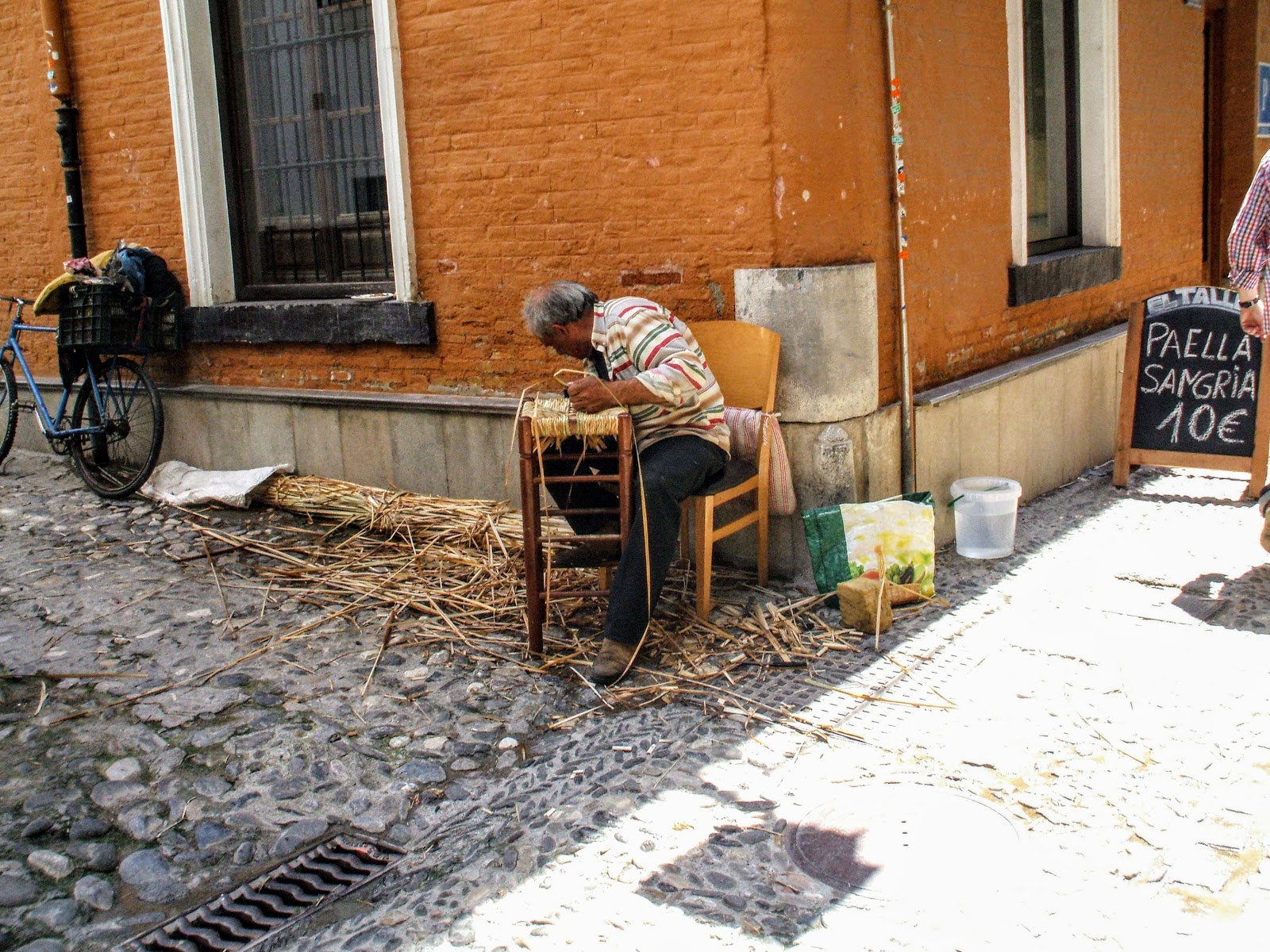
Furniture maker 
A Granada Dog!
We did come across one man making furniture on a side street. He was quite talented. 


NEXT: The Best Bakeries in Granada (and Dunkin' Donuts!) 


Thursday, June 21, 2018

Spain Trip #23: Barcelona:Cathedral Generalitat, Gargoyles, Tortured Saint, Aqueduct & Walkway Bridge

Tom and Rob at the Walkway bridge
In this blog about our trip to Spain, we're still in Barcelona exploring the sites. One of the places we visited was the massive Cathedral Generalitat. On the right side of the cathedral there is still part of an ancient Roman aqueduct! There's also a famous picture spot on the side of the Cathedral where people stop in front of an elevated walkway bridge between buildings. You'll also learn about the gargoyles and a famous, tortured saint in this blog. 

WALKWAY BRIDGE- Connecting the back of the Cathedral to another building is an enclosed and architecturally beautiful bridge. We don't know the history of it, but paused for a photo in front of it. 


Cathedral Generalitat
ABOUT CATHEDRAL GENERALITAT - The Cathedral of the Holy Cross and Saint Eulalia also known as Barcelona Cathedral, is the Gothiccathedral and seat of the Archbishop of Barcelona, Spain. The cathedral was constructed from the 13th to 15th centuries, with the principal work done in the 14th century.

ABOUT THE ARCHITECTURE & GARGOYLES - The roof is notable for its gargoyles, featuring a wide range of animals, both domestic and mythical. It is a pseudobasilica, vaulted over five aisles, the outer two divided into chapels. The transept is truncated. The east end is a chevet of nine radiating chapels connected by an ambulatory. The high altar is raised, allowing a clear view into the crypt.


A Gargoyleson Cathedral Generalitat
STORY OF THE MARTYRED AND TORTURED SAINT - The cathedral is dedicated to Eulalia of Barcelona, co-patron saint of Barcelona, a young virgin who, according to Catholic tradition, suffered martyrdom during Roman times in the city. One story says that she was exposed naked in the public square and a miraculous snowfall in mid-spring covered her nudity. The enraged Romans put her into a barrel with knives stuck into it and rolled it down a street (according to tradition, the one now called Baixada de Santa Eulàlia). The body of Saint Eulalia is entombed in the cathedral's crypt.

Rob outside Cathedral Generalitat
NEXT: THE ANCIENT ROMAN RUINS AND THE GHOST!  


Tuesday, June 19, 2018

Spain Trip #21: Barcelona: Park Guell part 2: Salamander, Aquaduct, Marketplace

Doug, Scott and Tom in the Marketplace
In today's blog, Part 2 of the Park Guell visit, you'll see the "Marketplace" part of the big park and learn about the aqueduct and the famous Salamander. 

Marketplace columns

WHO IS PARK GUELL NAMED FOR? Park Güell is named after Eusebi Güell, a wealthy Catalonian entrepreneur and influential member the Barcelona bourgeoisie. A close friend of Gaudí, he commissioned several of his works including Palau Güell, Bodegas Güell, Pabellones de la Finca Güell and the Colonia Güell crypt.

THE MARKETPLACE - This area is a huge area designed for vendors to sell wares. It has many massive columns that support a wavy shaped roof. Gaudí made efforts to make this space unique. Wavy shapes are reminiscent of flowing lava. The columns made the structure look like something 
out of Greece. 
Outside the marketplace there are also covered walkways with columns shaped like trees.

The Aqueduct that runs around the park 
WHAT IS THE AQUEDUCT - Antoni Gaudi designed the park with an aqueduct so people could get fresh drinking water.  He set up water collection systems throughout the park. The aqueduct was supported by crazy rock-like columns that went through the park. They were a mix of art and practicality.

THE FAMOUS SALAMANDER - A large and brightly colored, tiled salamander sits near the top of the stairs of the Marketplace area in the Park Guell. Fresh water from the aqueduct comes out of the salamander's mouth. 
Rocklike columns under the aqueduct
  As you go through Barcelona, you'll see this brightly colored Salamander on a LOT of TEE SHIRTS- Now you know the source of it. It's part of the aqueduct in Gaudi's Park Guell. 

AN OBSERVATION - There was actually very little information about the park. It seemed more as a place to walk around and enjoy the gardens that surrounded the odd looking structures. After a walk through the park, we then visited the residence of Antoni Gaudi, that sat at the top of the hill overlooking the park. That's our next blog! 
The Salamander

NEXT: Antoni Gaudi's House (Museum)


Monday, June 18, 2018

Spain Trip #20: Barcelona: Park Guell part 1

Gaudi Building #2 
In today's blog about our trip to Spain, we're going to take you to the famous "Park Guell" located on a hill atop the city of Barcelona. This park was designed by Antoni Gaudi, of whom you learned about in the previous blog on the Sagrada Familia basilica.

WHAT IS PARK GUELL? The Park Güell is a public park system composed of gardens and architectonic elements located on Carmel Hill, in Barcelona, Catalonia. Carmel Hill belongs to the mountain range of Collserola – the Parc del Carmel is located on the northern face.

ADMISSION: Although it's a public park there is an admission charge to get in it. There are also two buildings designed by Antoni Gaudi, and a "marketplace" with columns. TO BUY A TICKET: https://www.parkguell.es/en/portada

WHO DESIGNED IT? Three Architects: Antoni Gaudí, Josep Maria Jujol, Joan Rubió

WHAT WAS IT'S PURPOSE? I was a large park constructed beginning in 1900, but completed in 1914. It was created to be part of a self-contained suburb for the wealthy that included public areas. In the center of the park today sits an elementary school for the neighborhood children.
Gaudi building #1

stonework in building #1
 WHY WAS IT A FAILURE? The idea for the park was to be the center of a neighborhood for the wealthy. The elite were pitched the idea of having homes built around the park. Only 4 homes were purchased, so the project and the idea became a failure. By 1922, after 8 years of trying, the park was donated to the City of Barcelona.

 AMAZING TILE WORK - Gaudi's designs included amazing, detailed tile work. Multicolored tiles were everywhere and on everything!  From the inside to the outside of buildings. Tiny colored tiles lined the back of cement park benches. 

Scott sits on one of the ornamental tiled park benches 
FAST FACT: In 1984, UNESCO declared Park Güell a World Heritage Site. barcelonaexperience.com

OUR OBSERVATION: There was a lot of construction happening in the park. The main portion of the park consisted of the "Marketplace" which you will see in the next blog. The top part of that marketplace was under construction, with earth moving equipment placing dirt over it, and leveling it. Some of it was fenced off so visitors could not access the park. 

Tile in detail


NEXT: The Marketplace & Aqueduct

Entry way from the top of the hill

Monday, June 11, 2018

Spain Trip #17: Barcelona's Sagrada Familia: Crypt and 2 Ghosts

Antoni Gaudi's Crypt. 
In this blog about the Sagrada Familia Basilica in Barcelona, we'll get right to the dead things: The crypt and the ghosts we discovered (and encountered) while we were touring the church. Since we both have the ability to sense ghosts, we were busy sight-seeing and listening to a couple of dead people. 

WHO IS IN THE UNDERGROUND CRYPTCrypt of the basilica of La Sagrada Familia. The Nativity façade and Crypt of the Basilica of the Sagrada Familia have been declared UNESCO World Heritage Sites, together with another six works by Antoni Gaudí. It contains the tomb of the famous architect. This is an underground level located beneath the apse.

GHOST #1 - At the west entrance to the Basilica, I (Rob) felt very dizzy. There was a male ghost who was standing next to me. He was strong, and stubborn. As soon as I felt him, Tom asked me if I were dizzy because he was, too!  The ghost was trying to get rhrough to both of us. 
Sagrada Familia
WHO WAS HE? He told me he was a construction worker who died while working on the church. He said that he lived in the late 1800s and early 1900s when an accident took his life. I believe that he fell from up high. 

GHOST #2 At the entrance to the gift shop, another male ghost kept vying for my attention. He made me even more dizzy than the first ghost. It was just before I ascended the stairs with the group that he hit me with a wave of energy (ghosts are energy) and made me feel like my head was spinning! 
WHO WAS HE?  He shouted in my ear "Pedro" (Spanish for Peter). He told me that he was also working on the basilica as a stoneworker. He said that a stone had fallen and crushed the right side of his head, killing him. He was just 37 years old when he died and he awoke confused, so he stayed behind as a ghost. 
 A scale model of the Basilica on display
Circle: Where Pedro's Ghost is located

GHOSTLY RESIDUAL ENERGY - Inside the Basilica, as is the case with most churches, there was a lot of residual emotional energy. That is, the emotions that people felt when they went into the church were impressed upon or absorbed by the walls. That could be happiness, sadness, grief, thankfulness, misery, etc. When living people walk in, they bring in energy of their own and that residual emotional energy "lights up" and makes the living experience those emotions.


NEXT: Some Gaudi Lights


Friday, June 8, 2018

Spain Trip #16: Barcelona: Sagrada Familia's Reverse Stained Glass Windows

Fire colors from the eastern side : Tom Willaiams
In this Spain trip blog, we're still exploring the Basilica called Sagrada Familia, and we'll highlight the stained glass and colors inside the structure. In this blog you'll learn about the backwards stained glass windows (from other churches) and Gaudi's color scheme.

IT'S BACKWARD FROM THE STANDARD  - As an architect who has studied Cathedrals and churches, Tom said that stained glass windows on the east-facing side of churches are usually blues, greens and cool colors. On the west, as the sun sets, churches usually have reds, yellows and oranges. In Sagrada Familia, it was totally opposite.Tom said that it looks like fire on one side and ice on the other. Why it's reversed in this Basilica, we have no idea. There's nothing written about it. 

Ceiling. Credit: Gary Alan Raymond 
GAUDI'S USE OF LIGHT - According to the Website for Sagrada Familia,  "Gaudí made great use of light to endow his architecture with expressivity and grandeur. Sunlight glistens on the pinnacles of the towers and windows. The rising sun lights up the portals of the Nativity facade, accentuating the joy for life that is the birth of Jesus.

On the Passion facade the interplay of light and shadow produced by the setting sun heightens the sparse and severe character of the facade’s theme, while the Glory facade receives the mid-day sun that will shine on the 16 lanterns of the monumental porch and light up the main entrance to the basilica."
Credit: Tom Williams
Altar with weird lights. Cr: Tom Williams


QUOTE: Gaudí said that color was the expression of life, which is why he decided to make its presence felt in the Sagrada Familia. 

FAST FACTS -  There are 53 columns inside. They are 180 feet high. 

NEXT: The Crypt and Ghosts Who Haunt Sagrada Familia

Source: http://www.sagradafamilia.org/en/light-and-colour/


Thursday, June 7, 2018

Spain Trip #15: Barcelona: Sagrada Familia Basilica

Sagrada Familia Basilica
Today's Spain Trip blog will take you to the famous Sagrada Familia basilica in Barcelona.
  There are some interesting and quirky things about it. When we saw it, I (Rob) described it as something out of "Harry Potter." It's also partly designed by Antoni Gaudi, the artist/architect we met a couple of blogs back (who went mad, was hit by a tram and died 3 days later in a hospital).
   In this blog we'll tell you a bit about the history, 6 towers, a "blocky artistic part" 

The artistic blocky facade
HISTORY OF THE BASILICA - The laying of the basilica's cornerstone happened in 1882. That was 136 years ago. Currently, 70% of the Basilica is finished and we are working on building the six central towers.

FOUR APOSTLE TOWERS - Called the "Towers of the evangelists" the towers of Matthew, Mark, Luke and John are now at 86.82 meters high but will reach 135 meters by 2022, according to the plan..
THE JESUS TOWER or "Tower of Jesus Christ" will be the tallest, at 172.5 meters high.
TOWER OF THE VIRGIN MARY - Is located over the apse and stands 138 meters tall

THE BLOCKY ARTISTIC OUTSIDE PART IS CALLED THE "PASSION FACADE" - In 2017, the sculptures of the lion of Judah and lamb of Abraham, two symbols of Jesus Christ from the Old Testament, were put on the outer acroterions of the upper portico.
Gaudi's "melting wax" side of the Basilica

LOOKS LIKE MELTING CANDLEWAX - One side of the Basilica is so heavily ornamented that from a distance it looks like melting candle wax. It's actually pretty creepy looking.  Appropriately enough, there were some ghosts in the building, which we'll explain in the next blog. 

ARCHITECTURAL NOTE: An "acroterion" is an architectural ornament placed on a flat pedestal called the acroter or plinth, and mounted at the apex or corner of the pediment of a building in the classical style.
In 2018, the elements of the upper narthex (an antechamber or large porch in a modern church) will be completed with the scene of the empty tomb placed behind the central columns and the holy cross in the central acroterion. The empty tomb scene, by sculptor Francesc Fajula, has already been put in place. This sculpture group comprises the figure of the angel, which weighs 3.8 tonnes, and the figures of the three Marys, each 3 meters tall. The stone cross is finished and the angels that will go with it are being sculpted now.

WHO WAS ANTONI GAUDI? An architect, artist, carpenter, glassmaker, locksmith. (1852-1926)  In 1878, he qualified in Architecture. In 1883 he took over the design of the Sagrada Familia. He worked on it for 43 years until his death in 1926.

GAUDI'S DESIGN -Gaudí’s conception of the Sagrada Familia was based on the traditions of Gothic and Byzantine cathedrals. His intention was to express Christian belief through the architecture and the beauty of the building and communicate the message of the Evangelists.

NEXT: A TOUR OF THE INSIDE,  STAINED GLASS WINDOWS IN REVERSE

Wednesday, June 6, 2018

Spain Trip #14: Barcelona Celebrates "George and the Dragon" on April 23rd

Carpaccio’s St. George and the Dragon (1502)

At the conclusion of our Barcelona bike tour we learned about a famous regional story of "George and the Dragon" and it's local significance. We were told that you can't visit Barcelona and not know about this story. 
  And we learned that April 23rd is a day called "St. George's Day." It is celebrated in the Aragon region of Spain. Here's the Legend :  

In Montblanc there was a dragon attacking the kingdom. Scared to death, the inhabitants decided to give two lambs every day to the dragon to satisfy its hunger and prevent attack on the village. But when the animals became scarce it was decided to send a person, chosen by drawing lots, and a lamb. When a family member was devoured by the dragon, the family received a rich compensation from the Kingdom's Treasury.

There are two versions of the legend at this juncture: the first one involves people getting tired of no member of the royal family being sent and therefore decide that the princess should be sent to the Dragon; while the second version says that one day a princess was chosen by drawing lots to accompany the lamb. 

In any case, on the cave of the dragon, the princess found a gentleman or knight of the name Jordi (George) and he slew the dragon by stabbing his sword into it and rescued her. From the blood that flowed from the lifeless body of the monster was born a red rose which the gentleman handed to the princess.

The king offered the gentleman all the riches imaginable but he preferred that the riches be allocated to the inhabitants of the kingdom. In addition, a church was built in his name, from which flowed miraculous water that was able to heal the sick. (Source: Wikipedia)
Día de San Jorge, Plaza de AragónZaragoza

THE APRIL 23RD CUSTOM TODAY - Today in Catalonia, Balearic and parts of Valencia, it is customary on 23 April for men give away roses to women, like the knight who addressed the princess. The women give the men a book, remembering the death and burial respectively of two great European literary personalities, Miguel de Cervantes and Shakespeare, and the Spanish notable literary personality, Inca Garcilaso.


WHY APRIL 23RD?  St. George's Day is celebrated annually on 23 April, as this is the generally accepted date of St. George's death. 
WHO WAS GEORGE?  Saint George became the patron saint of the former Crown of Aragon, when King Peter I of Aragon won the Battle of Alcoraz in 1096. Tradition says that St George appeared at a critical moment for the Christian Army, aiding them to win the battle for the "True Faith". St George is also the patron saint of England, Portugal, Georgia, Serbia, Bulgaria, Bosnia and Herzegovina, the Republic of Macedonia, and many cities across Europe. St. George was a cavalryman in the Roman army at Lydda, now in modern-day Israel. He was a Christian at a time when Rome was ruled by the emperor Diocletian, who was anti-Christian. He refused to make sacrifices to the Roman gods. As a result, he was tortured over several years and eventually suffered a martyr's death, when he was beheaded in 303 AD. He began to be venerated around the fifth century when a monastery was built and dedicated to him in Jerusalem.
NEXT: EUROPE'S MOST VISITED BASILICA: SAGRADA FAMILIA

Who I am

I'm a simple guy who enjoys the simple things in life, especially our dogs. I volunteer for dog rescues, enjoy exercising, blogging, politics, helping friends and neighbors, participating in ghost investigations, coffee, weather, superheroes, comic books, mystery novels, traveling, 70s and 80s music, classic country music,writing books on ghosts and spirits, cooking simply and keeping in shape. You'll find tidbits of all of these things on this blog and more. EMAIL me at Rgutro@gmail.com - Rob

A Classic Country Music Station to Enjoy