Showing posts with label Neil deGrasse Tyson. Show all posts

Friday, August 11, 2017

In the Comics: Astrophysicist Neil DeGrasse Tyson Meets Superman

As both a scientist and a Superman fan, there was one story that DC Comics published in 2012 involved both Superman and Neil deGrasse Tyson... where Neil helped Superman see the last light from the exploding planet Krypton. 
 - There is a cool 6 minute video that explains how the story came together, too (see below).
- Rob

Here's the story of how it came to be from the American Museum of Natural History:
 Action Comics #14, published in November 2012 by DC Comics, reveals that even Superman visits the Museum’s Hayden Planetarium—and not just to see the Space Show.
The superhero, it turns out, comes once a year to see images of his far-off home planet, Krypton, said to orbit its home-star every 382 days. To locate the fictional planet in the actual sky, DC Comics worked with astrophysicist Neil deGrasse Tyson, director of the Museum’s Hayden Planetarium. “When an artist’s muse leads to scientific themes,” says Tyson, “we are there to help out.” Tyson elaborates on the process in this video.
VIDEO ON HOW THE STORY HAPPENED: https://youtu.be/uZYLN_Ouu5U

CAPTION: During a roundtable discussion with journalists, Hayden Planetarium Director Neil deGrasse Tyson explains how he helped Superman find his home planet of Krypton. Tyson appears as a character in the recent DC Comics' ACTION COMICS #14, "Star Light, Star Bright." In real life, he consulted a star index and found a real star that supported the backstory of the comic.  The red dwarf star designated for having the ability to support a Krypton-like planet is located in the constellation Corvus 27.1 light years from Earth. The star, designated LHS 2520, possesses a red, highly turbulent surface, somewhat cooler and smaller than the Sun. To find it in the night's sky, amateur astronomers and Superman fans can follow these coordinates: J2000
Right Ascension: 12 hours 10 minutes 5.77 seconds
Declination: -15 degrees 4 minutes 17.9 seconds
Proper Motion: 0.76 arcseconds per year, along 172.94 degrees from due north


FIRST TASK: TYSON DETERMINES KRYPTON ORBITED STAR LHS 2520 IN CORVUS CONSTELLATION
Tyson’s first task was to figure out where the planet Krypton would be located in the galaxy. Using the facts of Superman’s fictional life—such as his age, about 27—Tyson studied published catalogs of known stars to determine a few possible candidates about 27 light years from Earth, around which Krypton might orbit.
After hearing about the candidates, DC Comics homed in on one—a star known as LHS 2520—because it was within the night-sky constellation Corvus, which is Latin for crow. As Superman aficionados know, the mascot of Smallville High School—which Clark Kent attends growing up—is the Crow.
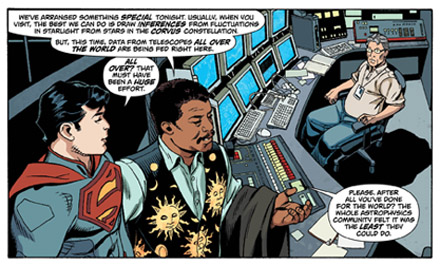
Superman and Tyson
A panel from Action Comics #14, featuring Superman and Neil deGrasse Tyson.
© DC Comics
Back on Earth, astronomers don’t know whether LHS 2520 has any planets orbiting it. But over the past two decades, many astronomers have discovered planets orbiting stars other than our Sun. Though only a small portion of the sky has been surveyed so far, about 800 of these exoplanents have already been discovered, with thousands more observed but not yet confirmed.
Still, distant stars like LHS 2520 are not easily observed; in fact, no telescope today is strong enough to see details of planets as far off as the fictional Krypton would be. To actually see a planet 27 light years away, says Tyson, a telescope “would have to be the width of the Earth!”
Instead, today, exoplanet researchers mostly observe exoplanets indirectly, by watching the effects of a planet’s gravity on the star, or the tiny eclipses that occur as planets “transit,” or cross, a star.
But astrophysicists can combine the powers of telescopes placed at a distance from one another to amplify their powers of observation. Called interferometry, this method, for now, utilizes small telescopes, not powerful enough to observe far-off Krypton-like exoplanets.
SECOND TASK: TYSON DEVISES PLAUSIBLE METHOD BY WHICH SUPERMAN CAN SEE HIS FAR-OFF HOME
To make the comic’s key plot point—Superman observing his home planet’s destruction—scientifically plausible, Tyson combined fact with fiction. In the comic, every actual visible-light telescope on Earth observes Krypton at the same moment, in effect creating a massive interferometer—a feat only possible in comics.
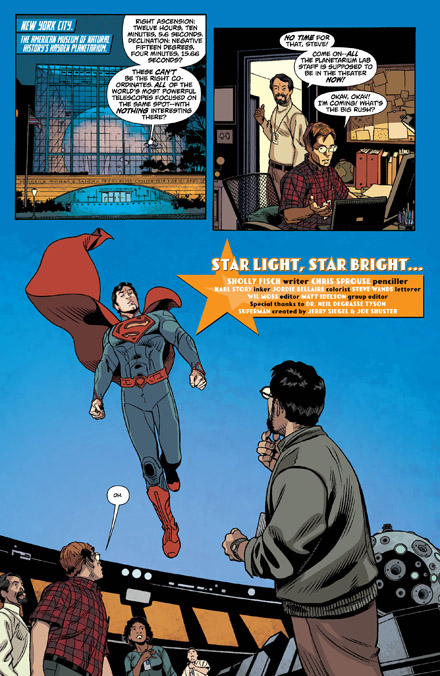
Superman Rose Center
© DC Comics
Sadly for Superman, this amazing technology allows him to observe the long-ago explosion of his home planet, the light from which has taken 27 years to reach Earth. “The Planet Krypton has been gone for years,” reads the comic. “But as far as Superman is concerned—Tonight is the night Krypton died.”

Thursday, August 10, 2017

Fascinating Book: Astrophysics for People in a Hurry by Neil DeGrasse Tyson

Neil's amazing book
As a scientist (meteorologist) and someone who works with astrophysicists, I had to read the brand
new book "Astrophysics for People in a Hurry" by Neil DeGrasse Tyson. In this 208 page book, you'll get a great idea of what the cosmos is made up of, and how things work.
   The book is easy to read, and although I've been working with astrophysicists for about 17 years, this provided some great basic science facts I never picked up. You'll learn about light, dark matter, dark energy, what's between planets, exoplanets, how scientists observe objects in various forms of light from Infrared to ultraviolet. You'll learn about radio waves from space, microwaves, gamma-rays, cosmic rays, etc. You'll understand how looking at objects tell us what they are made of.
   One of the lessons that stuck with me was "Matter tells space how to curve, and space tells matter how to move." That's because matter can warp space (like a magnifying lens).
   There are so many amazing things in this book that I didn't learn in college - and of course, there have been SO many findings on a daily basis with all the satellites we have observing the cosmos.
The day I met Neil at NASA in 2016
   In my job I also work with all of the Hubble Space Telescope findings on a daily basis, so this book as really "brought those to light" and made the findings even more exciting to me.
 - If you're an armchair scientist, love science, love the stars, or just like looking up, you should read this.There is so much more beyond this tiny speck called Earth and you'll be fascinated for a lifetime.
  BTW, I did get to meet Neil DeGrasse Tyson when he came to NASA in 2016. He's a cool guy!   - Rob

NEXT: Neil DeGrasse Tyson Meets Superman (well, sort of) 

ABOUT THE BOOK:  The #1 New York Times Bestseller: The essential universe, from our most celebrated and beloved astrophysicist.
What is the nature of space and time? How do we fit within the universe? How does the universe fit within us? There’s no better guide through these mind-expanding questions than acclaimed astrophysicist and best-selling author Neil deGrasse Tyson.
But today, few of us have time to contemplate the cosmos. So Tyson brings the universe down to Earth succinctly and clearly, with sparkling wit, in tasty chapters consumable anytime and anywhere in your busy day.
While you wait for your morning coffee to brew, for the bus, the train, or a plane to arrive, Astrophysics for People in a Hurry will reveal just what you need to be fluent and ready for the next cosmic headlines: from the Big Bang to black holes, from quarks to quantum mechanics, and from the search for planets to the search for life in the universe.

Wednesday, June 4, 2014

Rob Meets Neil Degrasse Tyson and Asks about his Superman Connection!

L to R: Neil, Eric Smith, Chris Scolese, John Mather, Paul Geithner
Neil answers my question about his Superman appearance!
One of the cool things about working at NASA is that we get to work with and meet interesting people.
  On June 3rd, Dr. Neil deGrasse Tyson visited  NASA Goddard's Space Flight Center and the James Webb Space Telescope team in Greenbelt, Md, and I (Rob) am one of the
Laura Betz put the entire event together!
science writers on the Webb telescope project and got to hear  meet him.


HIS SUPERMAN CONNECTION - Because I KNOW that he appeared in Action Comics #14 two years ago, I asked him about it and he was thrilled to tell everyone in the group about it!
  I went on line and learned that he also told NPR's Morning Edition. (LISTEN TO THE STORY- CLICK HERE)
    Here's the story: Hayden Planetarium director and pop-culture go-to science guy Neil deGrasse Tyson tells NPR's David Greene the story of how he came to lend a hand to Superman.
From Action Comics #14. Cr: DC Comics
DC Comics, Tyson explains, approached him for permission to use the Planetarium — as well as his likeness — in a story where Superman witnesses the destruction of Krypton, since the light from the distant planet is just now arriving on Earth. Tyson told DC Comics that he was happy to help, and that instead of just making up the story of Superman seeing Krypton, he could help them ground it in at least some actual science.  FULL NPR STORY: http://www.npr.org/blogs/monkeysee/2012/12/03/166246743/neil-degrasse-tyson-helps-his-new-bud-superman-get-a-glimpse-of-home

Neil Credit: NASA/Rebecca Roth
Neil talking about Cosmos as Rob poses for a picture


Who I am

I'm a simple guy who enjoys the simple things in life, especially our dogs. I volunteer for dog rescues, enjoy exercising, blogging, politics, helping friends and neighbors, participating in ghost investigations, coffee, weather, superheroes, comic books, mystery novels, traveling, 70s and 80s music, classic country music,writing books on ghosts and spirits, cooking simply and keeping in shape. You'll find tidbits of all of these things on this blog and more. EMAIL me at Rgutro@gmail.com - Rob

A Classic Country Music Station to Enjoy