Monday, March 23, 2020

From the United Kingdom: Missing cat reunited with owner after 11 years on the street

Here's a good news story from Birmingham, England... a cat, missing for 11 years, is finally reunited with her pet parent! Story from BBC News (March 6, 2020):

Missing cat reunited with owner after 11 years on the street


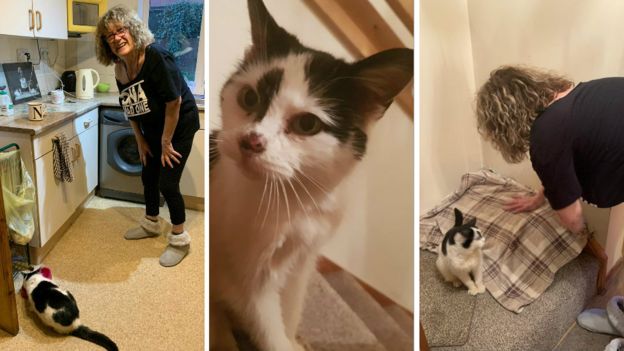
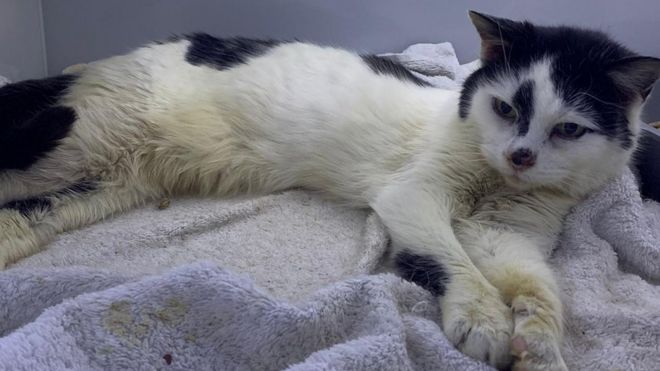
Missy was taken to an emergency vetsImage copyrightCLAIRE DAVIS
Image captionMissy is back after escaping from her owner's car in 2009

A cat that was missing for almost 11 years has been reunited with her owner - after living on the streets almost eight miles away from home.
Missy escaped from Eve McDonnell's car in 2009 at Five Ways in Birmingham and despite a search was never found.
But residents in Hall Green spotted the cat living amid rubbish and took her to a rescue centre where they discovered she was microchipped.
Ms McDonnell said she was in a "state of disbelief" Missy, now 17, was alive.
"I never stopped thinking about her. You just don't forget your pets - they are irreplaceable," she said, after an emotional reunion with Missy earlier this week.
Missy had escaped from Ms McDonnell's car when she stopped to buy some milk.

Missy at home with her owner in HarborneImage copyrightALI SHAH
Image captionMissy has been settling back into her old home

Ali Shah and his mother Salma had frequently seen Missy "camping" on a driveway near their home.
As winter hit, Mr Shah said the cat would still sleep on top of a bin or in piles of rubbish.
"When I spoke to the owner of the driveway, he informed me that the cat had one day simply followed him home and wasn't allowed in," he said.
The pair befriended Missy and would feed her and even built a wooden shed for her to sleep in.

The box Mr Shah made for MissyImage copyrightALI SHAH
Image captionResidents in Hall Green tried to make Missy's life comfortable on the street

After Mr Shah sent a video of Missy sleeping in the rain to his mother, she decided to rescue her, taking her into their home, where she stayed for several days before being taken to Little Haven Rescue in Sutton Coldfield.
Rescue centre owner Clare Davis took Missy to an emergency vets where a microchip was discovered and she was traced back to 72-year-old Ms McDonnell.
"Her spine was protruding all the way down her back, that's how skinny she came in. Her white fur is discoloured because she's been sleeping rough" she said.
Ms McDonnell said she felt a "mixture of emotions" at hearing Missy was still alive.
Missy has to eat kitten food, because she has lost many teeth, but has returned to her favourite place to sleep, on the stairs at their home in Harborne.
"She's had a rough time, but she's still my cat," she said.  "I can't believe she's alive, I never stopped thinking about her."

Sunday, March 22, 2020

Idiot and SOB of the Week: Congressman Andy Biggs- Voted AGAINST COVID19 Bill because it Includes Same-Sex Partners

Idiot and Bigot of the Week:  AZ Congressman Andy Biggs
Wow. Even in the midst of a world-wide pandemic that is killing thousands of people, leaving
countless people jobless, there's STILL an asshole. Yes, an asshole. He's beyond idiot. That's AZ Congressman Andy Biggs who voted AGAINST the COVID19 bill because it gives sick leave to same-sex partners. Yes, he's that bigoted and hateful. His hatred for gay people is so deep he would refuse help to anyone in the U.S. There are a lot of idiots, but this ass takes the trophy. People in Arizona, vote this SOB OUT! Here's the story from Newsweek on March 20>>>

REP. ANDY BIGGS VOTED AGAINST CORONAVIRUS BILL BECAUSE IT GIVES SICK LEAVE TO SAME-SEX PARTNERS
March 20, 2020 Newsweek

Arizona Republican Congressman Andy Biggs said during a Monday radio interview produced by the conservative Christian group, the Family Research Council (FRC), that he voted against the Families First Coronavirus Response Act (FFCRA) on Saturday because it included provisions for domestic partnerships, including same-sex relationships.

According to the Southern Poverty Law Center, the FRC has been labeled a hate group because of its fervid anti-LGBTQ stance.

Biggs was one of 40 Republicans who voted against the FFCRA, although the legislation was ultimately passed by the House of Representatives.

Language within the Emergency Paid Sick Leave Act, which is part of the overall economic package, defines both the terms "domestic partner' and "committed relationship."


Ads by scrollerads.com
"The term 'domestic partner,' with respect to an individual, means another individual with whom the individual is in a committed relationship," read the legislation.

"The term 'committed relationship' means a relationship between 2 individuals, each at least 18 years of age, in which each individual is the other individual's sole domestic partner and both individuals share responsibility for a significant measure of each other's common welfare," the bill continued. "The term includes any such relationship between 2 individuals that is granted legal recognition by a State or political subdivision of a State as a marriage or analogous relationship, including a civil union or domestic partnership."

Biggs took issue with the definitions by claiming the legislation attempted to redefine the meaning of 'family,' something Biggs claimed federal laws had never attempted to accomplish in the past.

"They've redefined family for the first time in a piece of federal legislation to include committed relationships," Biggs said. "The problem with that, of course, is it's really hard to define a committed relationship and it's really hard to define anything related to that and so they've tried to—they've put in, in my opinion—sort of an amorphous definition. But that leaves it wide open and then they expand it, expand on that."

Biggs also said that the provision has nothing to do with the coronavirus, but "that's just par for the course for the Left."

"While LGBTQ couples can be rightfully recognized in marriage today, many LGBTQ and non-LGBTQ Americans remain in domestic partnerships," GLAAD Chief Communications Officer Rich Ferraro told Newsweek. "Voting to harm his LGBTQ constituents and their children is nothing new, but using COVID-19 to do it is a new low for Representative Biggs."

"Representative Biggs' constituents, his wife Cindy Biggs, and their family should be ashamed and angry that during a national crisis when Americans are coming together, Representative Biggs is busy continuing his long campaign to harm LGBTQ families and also using his unethical relationships with anti-LGBTQ hate groups like the Family Research Council to inaccurately claim this relief bill would 'redefine family,'" Ferraro added.

Biggs and his wife have been previously linked with United Families International (UFI), a conservative Christian group noted for its stance against same-sex marriage. Representative Biggs was reportedly the group's policy adviser while his wife, Cindy, was the secretary and treasurer.

In an article published on UFI's website in February, the organization says that shifting the definition of marriage away from the traditional viewpoint of one man and woman "is to ignore a fundamental truth that gives substance to our understanding of how human beings interact, and how we teach this moral belief to our children."

"When marriage is undermined the healthy family is as well, and thus the strength of our nation," the article adds.
********************************
THIS ASSHOLE HAS A HISTORY OF BIGOTRY- On March 7, 2019, the Arizona Republic reported:
Arizona's Reps. Andy Biggs and Paul Gosar once again went against the grain in the House, opposing Thursday a resolution condemning bigotry in the wake of repeated comments by a freshman Democrat seen as anti-Semitic.
The Republican lawmakers were on the short end of a 407-23 vote on a resolution that condemned anti-Semitism and anti-Muslim bias.
Story: LINK

Saturday, March 21, 2020

CDC History: 1918 Pandemic Influenza Historic Timeline

What happened during the 1918 Pandemic Flu Epidemic? The CDC provided a timeline of the start and ending of the virus, and shockingly it lasted for about 10 months. But people took extreme measures. Schools and theaters were closed and public gatherings were stopped over that time period.

1918 Pandemic Influenza Historic Timeline

In 1918, a new influenza virus emerged. During this same time period World War I was taking place. The conditions of World War I (overcrowding and global troop movement) helped the 1918 flu spread. The vulnerability of healthy young adults and the lack of vaccines and treatments created a major public health crisis, causing at least 50 million deaths worldwide, including approximately 675,000 in the United States. Below is a historical timeline of major events that took place during this time period.
  • Timelineicon
    April 1917
    • U.S. enters World War I with 378,000 in the armed services.
  • Timelineicon
    June 1917
    • A draft is established to increase the number of soldiers; Army begins training recruits at 32 large camps, each housing 25,000 to 55,000 soldiers.
  • Timelineicon
    March 1918
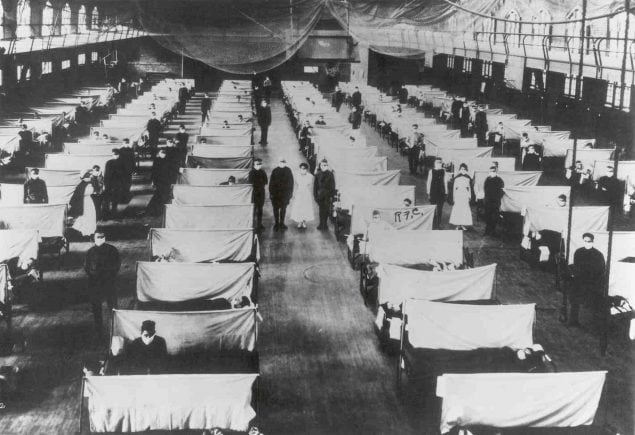
     Cots set up in gymnasium for flu patients
    • Outbreaks of flu-like illness are first detected in the United States.
    • More than 100 soldiers at Camp Funston in Fort Riley, Kansas become ill with flu. Within a week the number of flu cases quintuples.
    • Sporadic flu activity spreads unevenly through the United States, Europe, and possibly Asia over the next six months.
  • Timelineicon
    April 1918
    • First mention of influenza appears in an April 5 weekly public health report. The report informs officials of 18 severe cases and three deaths in Haskell, Kansas.
  • Timelineicon
    May 1918
    • By May, hundreds of thousands of soldiers travel across the Atlantic each month as they are deployed for World War I.
  • Timelineicon
    September 1918
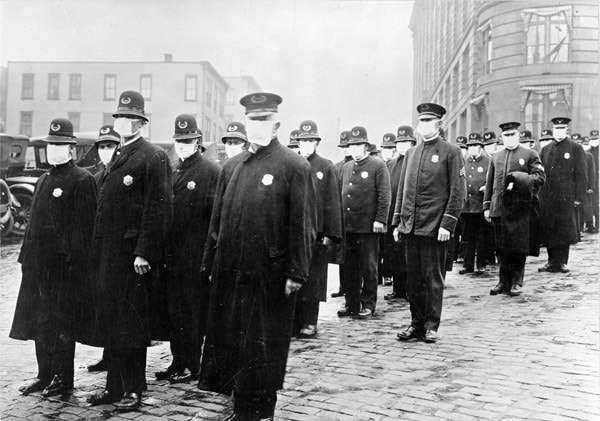
    Seattle police officers walking on the street with masks covering their faces.
    • The second wave of flu emerges at Camp Devens, a United States Army training camp just outside of Boston, and at a naval facility in Boston.
    • Between September and November, a second wave of flu peaks in the United States. This second wave is highly fatal, and responsible for most of the deaths attributed to the pandemic.
    • New York City’s Board of Health adds flu to the list of reportable diseases, and requires all flu cases to be isolated at home or in a city hospital.
    • By the end of September, more than 14,000 flu cases are reported at Camp Devens—equaling about one-quarter of the total camp, resulting in 757 deaths.
  • Timelineicon
    October 1918
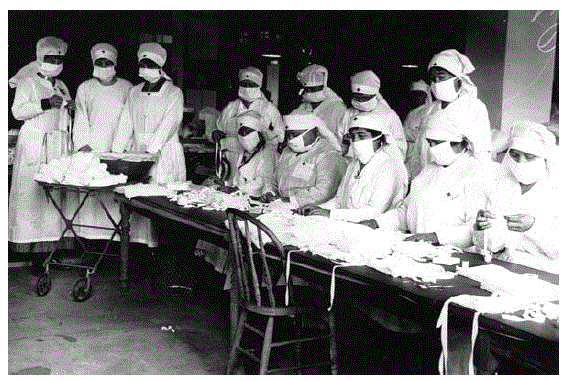
    Nurses assembling flu masks
    • The 1918 flu pandemic virus kills an estimated 195,000 Americans during October alone.
    • In fall of 1918 the United States experiences a severe shortages of professional nurses, because of the deployment of large numbers of nurses to military camps in the United States and abroad, and the failure to use trained African American nurses.
    • Chicago chapter of the American Red Cross issues urgent call for volunteers to help nurse the ill.
    • Philadelphia is hit hard with the pandemic flu viruses—more than 500 corpses await burial, some for more than a week. Cold-storage plants are used as temporary morgues, a manufacturer of trolley cars donates 200 packing crates for use as coffins.
    • Chicago, along with many other cities across the United States, closes theaters, movie houses and night schools and prohibit public gatherings.
    • San Francisco’s Board of Health requires any person serving the public to wear masks and issues strong recommendation to all residents to wear masks in public.
    • New York City reports a 40 percent decline in shipyard productivity due to flu illnesses in the midst of World War I.
  • Timelineicon
    November 1918
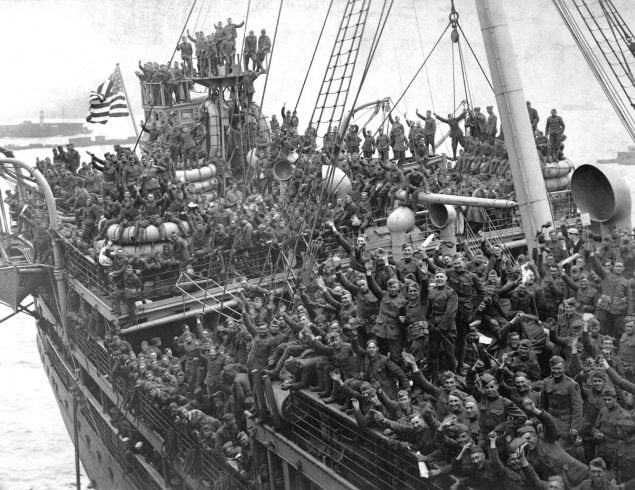
    American soldiers returning home on a large ship
    • The end of World War I enables a resurgence of influenza as people celebrate Armistice Day and soldiers begin to demobilize.
    • Salt Lake City officials place quarantine signs on front and rear doors of 2,000 homes where occupants have been struck with flu.
    • By the end of World War I the U.S. military grew in size from 378,000 soldiers in April 1918 to 4.7 million soldiers.
  • Timelineicon
    December 1918
    • Public health officials begin education programs and publicity about dangers of coughing and sneezing; careless disposal of “nasal discharges.”
    • Committee of the American Public Health Association encourages stores and factories to stagger opening and closing hours and for people to walk to work when possible instead of using public transport to prevent overcrowding.
  • Timelineicon
    January 1919
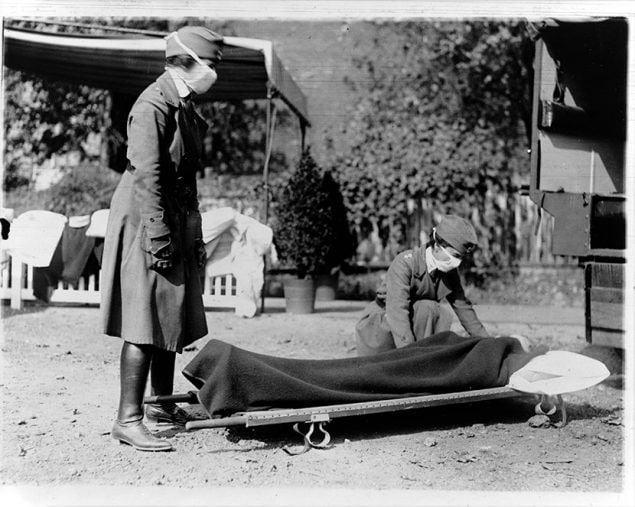
    Ambulance demo with two Red Cross nurses
    • A third wave of influenza occurs in the winter and spring of 1919, killing many more. Third wave subsides in the summer.
    • In San Francisco, 1,800 flu cases and 101 deaths are reported in first five days of January.
    • Many San Antonio citizens begin complaining that new flu cases aren’t being reported, and that this is fueling another influenza surge.
    • Seven-hundred and six cases of influenza and 67 deaths are reported in New York City, triggering fear of a recurrence of severe flu activity.
    • Trustees of the Boston City Hospital ask mayor for a special appropriation of $3,000 to study the treatment of influenza.
  • Timelineicon
    February 1919
    • Influenza appears to be nearly eradicated in New Orleans as number of reported cases drops.
    • Illinois passes a bill to create a one-year course to become a “practical nurse,” an effort to address the nursing shortage the pandemic had exposed.
  • Timelineicon
    April 1919
    • At Versailles Peace Conference, while negotiating the end of World War I with other world leaders, U.S. President Woodrow Wilson collapses. Some historians speculate he was weak from influenza, which was still rampant in Paris.

Friday, March 20, 2020

Franklin Turns 16 Years Old! What's it like to be a Senior Dog?

Franklin turned 16 years old in March 2020
We all celebrate birthdays in our own way, and Franklin, our red, smooth Dachshund celebrated his banner 16th birthday on March 18, 2020 and continues to celebrate. 
   Franklin was born in a litter of pups in South Carolina and Tom picked him out specially, because Franklin was not interacting with his littermates. 

STILL INDEPENDENT! 
Now that Franklin is in his golden years, he's maintained that puppy behavior!  He still likes to be off by himself and usually away from his other three canine siblings. 
MEDICATIONS:  As a senior, he's on pain medication (Galliprant) for his arthritis. He's also getting daily supplements of a probiotic, bladder supplement, Dasequin for joints and cranberry for his kidneys. 
WALKING CHALLENGES :  He does have difficulty standing up, especially in the morning. His back legs are weak, and that stemmed from his back surgery back in 2015. Although he can still walk around the neighborhood, it's just once a day and in the mid-day. He's not up to a morning walk (conversely, Dolly, his senior Weimaraner sister, prefers morning walks, and doesn't like doing them in the afternoon). 
FEEDING CHANGES:  Since his back legs aren't that cooperative, Franklin now wants his bowl of breakfast and dinner brought over to his bed (that he sits in most of the day). He still eats every crumb! (He eats Rachel Ray DISH dry food, with a teaspoon of Rachel Ray wet food on top).  
He's also obsessive about water drinking, likely because his kidneys continue to weaken. Regardless, he's well-fed, eats well and gets lots of treats (although the perfect weight). 

MOANING: Since he was 15 1/2 (Sept. 2019), Franklin started moaning at certain times during the day.  We noticed it was early morning (sometimes 3 am , usually 5am) - which I learned meant he wanted to go out and pee, but couldn't get up. Now he moans 1/2 hour before breakfast, 1/2 hour before dinner, and 1/2 hour before 3 treat time... 
Posing for a Menagerie Pic (L to R): Dolly, Tyler, Dash, Franklin
   
This is what it's like being in your golden years as a Dachshund! Feel free to wish him a happy birthday. 

BBC News- Interview w/COVID19 Victim (21 days at home in isolation)

On Friday, we posted the facts about Coronavirus 19, or COVID19. I've been wondering about what happens when people contract it. BBC News did this interview on March 13th and it was eye opening. One man has been in isolation for 21 days (and hasn't seen his son since). Fortunately, this guy is recovering (he's not asthmatic). Read his story here.

Coronavirus: 'The worst bit is the uncontrollable coughing'

BBC NEWS 12 March 2020
Related Topics


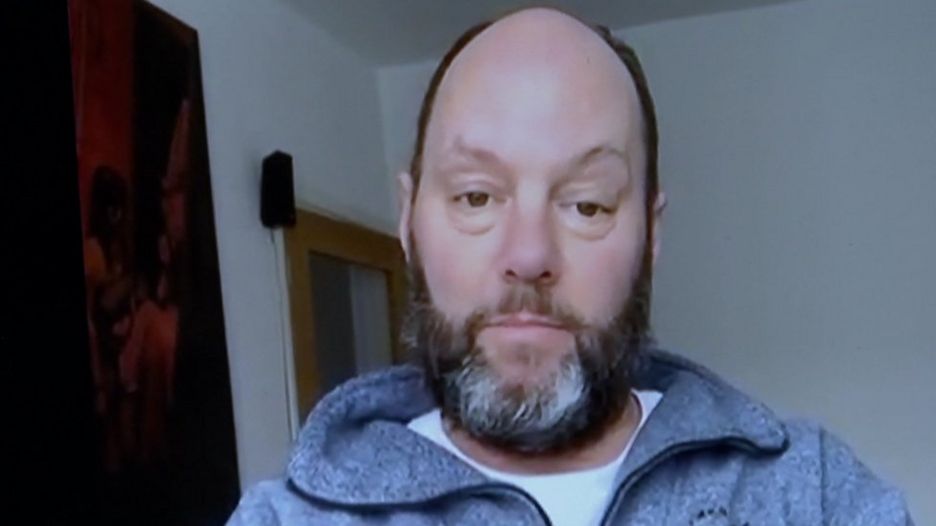
Andrew O'Dwyer
Image captionAndrew was infected with the virus when he was skiing in Italy

"The worst bit is the uncontrollable coughing," says Andrew O'Dwyer, who is recovering after being infected with the new coronavirus following a skiing trip to Italy in late February.
"I've had worse flu, without a doubt - but I wouldn't want to catch it again," he says during his self-isolation at home in south-west London.

Despite having type 1 diabetes, Andrew says having the virus "isn't anything to worry about for me personally".He adds that the fever he experienced is "no different to normal flu-type symptoms"."I've not been concerned," he says.
The severity of symptoms can vary widely among people. Those who are older and have pre-existing medical conditions (such as asthma, diabetes, heart disease) are more likely to become severely ill and can need hospital treatment.

There have been 10 coronavirus-related deaths so far in the UK.Andrew was told the virus wasn't circulating in the resort he was staying in, but 21 out of 25 people in his skiing group have since become infected.
On his return from Italy to the UK, he decided to stay at home and self-isolate as a precaution, despite experiencing no symptoms at that point.

'Debilitating cough'Some people in his group fell ill within two days, so he contacted NHS 111, which he says was "very good"."I got tested before I was feeling ill because other people had tested positive."I found out three days later I was positive. But it was over a week before I showed symptoms," he says.They included a "quite debilitating cough" and a high temperature that kept rising and falling.He says he found that taking paracetamol really helped to reduce his fever.At one point he was told to go to hospital in an ambulance for a routine assessment.He was checked over but didn't have to get out. Then he was dropped off at home again.

Andrew is now on the road to recovery - but it's been a long haul.By the end of his self-isolation he will have spent 21 days at home, without going out.He's also been trying to work from home but has found it difficult to concentrate."It's like climbing the walls. It's difficult to do a day's work," he says.
On a positive note, he says his friends have been very good, helping him with shopping. However he's really missed his nine-year-old son, whom he hasn't seen for two weeks.

Who I am

I'm a simple guy who enjoys the simple things in life, especially our dogs. I volunteer for dog rescues, enjoy exercising, blogging, politics, helping friends and neighbors, participating in ghost investigations, coffee, weather, superheroes, comic books, mystery novels, traveling, 70s and 80s music, classic country music,writing books on ghosts and spirits, cooking simply and keeping in shape. You'll find tidbits of all of these things on this blog and more. EMAIL me at Rgutro@gmail.com - Rob

A Classic Country Music Station to Enjoy